
Educeri
  • Curriculum
  • Lessons
  • How to Teach
  • Professional Development
  • Log In
  • Subscribe

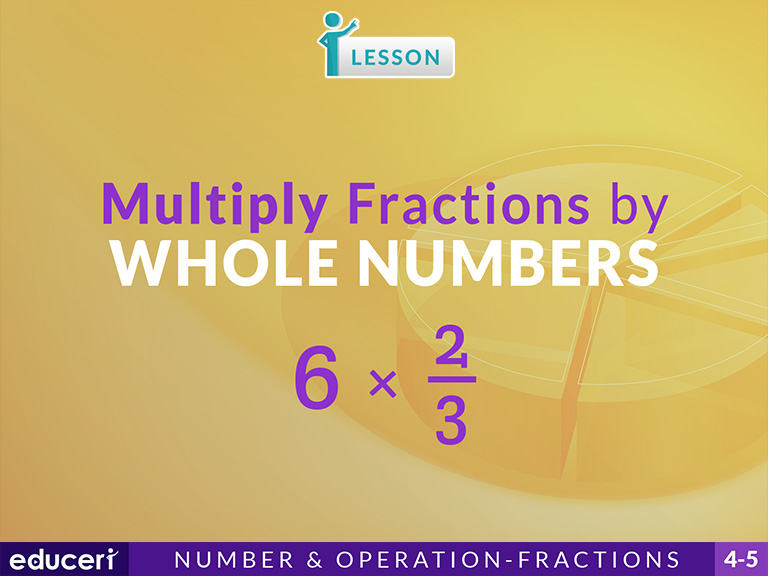
Multiply Fractions by Whole Numbers

12 people have favorited this lesson!

Share

Multiply Fractions by Whole Numbers

TEKS Math: 5.3.I

(I) Represent and solve multiplication of a whole number and a fraction that refers to the same whole using objects and pictorial models, including area models

AU Math: ACMNA107

(Y5) Describe, continue and create patterns with fractions, decimals and whole numbers resulting from addition and subtraction (ACMNA107)

CCSS Math: 4.NF.4.B

4.NF.4.B Understand a multiple of a/b as a multiple of 1/b, and use this understanding to multiply a fraction by a whole number. For example, use a visual fraction model to express 3 × (2/5) as 6 × (1/5), recognizing this product as 6/5. (In general, n × (a/b) = (n × a)/b.)

5.NF.4.A

5.NF.4.A Interpret the product (a/b) × q as a parts of a partition of q into b equal parts; equivalently, as the result of a sequence of operations a × q ÷ b. For example, use a visual fraction model to show (2/3) × 4 = 8/3, and create a story context for this equation. Do the same with (2/3) × (4/5) = 8/15. (In general, (a/b) × (c/d) = (ac)/(bd).

Share This Lesson


Log in to view this lesson. If you do not have an account, subscribe now and begin your free 30 day trial.

Standard Alignments:

TEKS Math: 5.3.I

(I) Represent and solve multiplication of a whole number and a fraction that refers to the same whole using objects and pictorial models, including area models

AU Math: ACMNA107

(Y5) Describe, continue and create patterns with fractions, decimals and whole numbers resulting from addition and subtraction (ACMNA107)

CCSS Math: 4.NF.4.B

4.NF.4.B Understand a multiple of a/b as a multiple of 1/b, and use this understanding to multiply a fraction by a whole number. For example, use a visual fraction model to express 3 × (2/5) as 6 × (1/5), recognizing this product as 6/5. (In general, n × (a/b) = (n × a)/b.)

5.NF.4.A

5.NF.4.A Interpret the product (a/b) × q as a parts of a partition of q into b equal parts; equivalently, as the result of a sequence of operations a × q ÷ b. For example, use a visual fraction model to show (2/3) × 4 = 8/3, and create a story context for this equation. Do the same with (2/3) × (4/5) = 8/15. (In general, (a/b) × (c/d) = (ac)/(bd).


Log in to view this lesson. If you do not have an account, subscribe now and begin your free 30 day trial.

Quiz has been requested!

Please wait for good news!

Educeri A product of DataWORKS Educational Research


Terms & Conditions Privacy
> >