
Educeri
  • Curriculum
  • Lessons
  • How to Teach
  • Professional Development
  • Log In
  • Subscribe

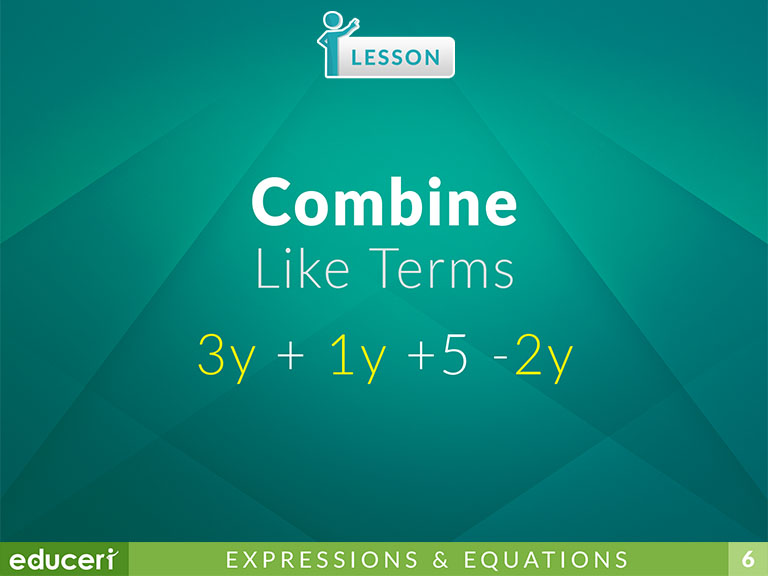
Combine Like Terms

7 people have favorited this lesson!

Share

Combine Like Terms

TEKS Math: 6.7.D

(D) Generate equivalent expressions using the properties of operations: inverse, identity, commutative, associative, and distributive properties.

AU Math: ACMNA192

(Y8) Simplify algebraic expressions involving the four operations (ACMNA192)

CCSS Math: 6.EE.3

6.EE.3 Apply the properties of operations to generate equivalent expressions. For example, apply the distributive property to the expression 3 (2 + x) to produce the equivalent expression 6 + 3x; apply the distributive property to the expression 24x + 18y to produce the equivalent expression 6 (4x + 3y); apply properties of operations to y + y + y to produce the equivalent expression 3y.

6.EE.4

6.EE.4 Identify when two expressions are equivalent (i.e., when the two expressions name the same number regardless of which value is substituted into them). For example, the expressions y + y + y and 3y are equivalent because they name the same number regardless of which number y stands for.

Share This Lesson


Log in to view this lesson. If you do not have an account, subscribe now and begin your free 30 day trial.

Standard Alignments:

TEKS Math: 6.7.D

(D) Generate equivalent expressions using the properties of operations: inverse, identity, commutative, associative, and distributive properties.

AU Math: ACMNA192

(Y8) Simplify algebraic expressions involving the four operations (ACMNA192)

CCSS Math: 6.EE.3

6.EE.3 Apply the properties of operations to generate equivalent expressions. For example, apply the distributive property to the expression 3 (2 + x) to produce the equivalent expression 6 + 3x; apply the distributive property to the expression 24x + 18y to produce the equivalent expression 6 (4x + 3y); apply properties of operations to y + y + y to produce the equivalent expression 3y.

6.EE.4

6.EE.4 Identify when two expressions are equivalent (i.e., when the two expressions name the same number regardless of which value is substituted into them). For example, the expressions y + y + y and 3y are equivalent because they name the same number regardless of which number y stands for.


Log in to view this lesson. If you do not have an account, subscribe now and begin your free 30 day trial.

Quiz has been requested!

Please wait for good news!

Educeri A product of DataWORKS Educational Research


Terms & Conditions Privacy
> >