All Lessons
Cite Textual Evidence to Support Inferences
This reading informational text lesson covers how to cite the textual evidence that most strongly supports what the text says explicitly as well as inferences are drawn from the text. The less This skill and concept should expand into larger works of informational text as the year progresses. The term conclusion is used in some assessments to evaluate inference (Smarter Balanced). Students will need to know that conclusion and inference are sometimes used interchangeably.
Share This Lesson
Analyze How an Author Acknowledges Conflicting Evidence or Viewpoints
This reading informational text lesson covers how an author deals with conflicting viewpoints in a text. The lesson includes research-based strategies and strategic questions that prepare students for assessments. In this lesson, students will identify the author's point of view and analyze how he or she acknowledges or responds to conflicting viewpoints.
Share This Lesson
Organize an Argument Logically
This reading comprehension lesson focuses on evaluating the logic of text. The lesson includes research-based strategies and strategic questions that prepare students for assessments. In this lesson, students read the text and identify the sentence that states the author's argument. Then, they identify other sentences that provide consistent support for the argument. If all examples support the argument, then they can determine that the argument has logic. In addition to the lesson, there are eight pages of Independent Practice and review modeled on current adaptive testing methods.
Share This Lesson
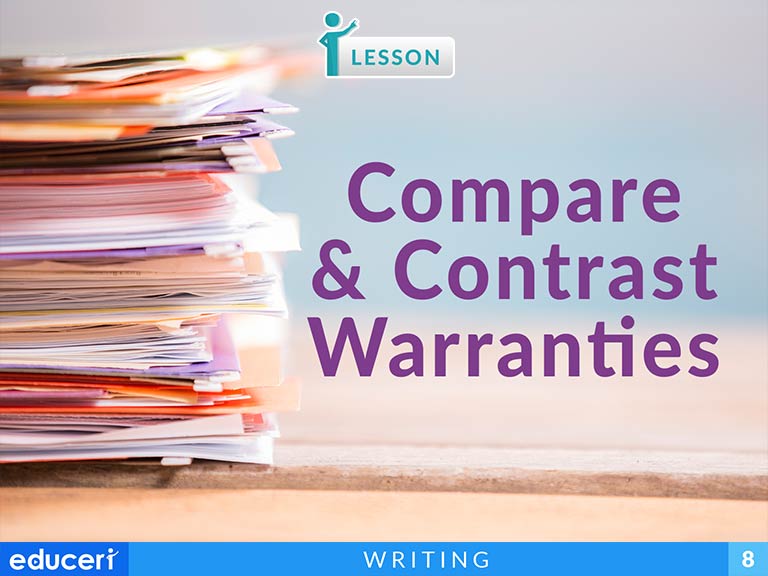
Compare & Contrast Warranties
This reading comprehension lesson focuses on comparing and contrasting warranties. The lesson includes research-based strategies and strategic questions that prepare students for assessments. In this lesson, students review a series of questions about a warranty and then scan the warranty to identify the answers and write them in a graphic organizer. Finally, they compare and contrast how two warranties are the same or different. In addition to the lesson, there are five pages of Independent Practice and review along with warranty glossary terms. The questions are modeled on current adaptive testing methods.
Share This Lesson
Analyze Author's Argument in a Text
This reading comprehension lesson focuses on analyzing proposition-and-support patterns in text. The lesson includes research-based strategies and strategic questions that prepare students for assessments. In this lesson, students read the text and identify the proposition. Then, they determine words or phrases that support the author's proposition and those that do not support it. Finally, they explain how the author's proposition was supported. In addition to the lesson, there are four pages of Independent Practice and review modeled on current adaptive testing methods.
Share This Lesson

Synthesize Content from Several Sources
This reading comprehension lesson focuses on finding similarities and differences between texts in the scope of ideas. The lesson includes research-based strategies and strategic questions that prepare students for assessments. In this lesson, students read both documents to find similar ideas covered in each. Then, they find differences in scope by answering a question about the text and explaining which difference has more details on the idea. In addition to the lesson, there are four pages of Independent Practice and review modeled on current adaptive testing methods.
Share This Lesson

Evaluate Claims and Counterclaims in an Opinion Piece
This reading comprehension lesson focuses on evaluating the unity of the text. The lesson includes research-based strategies and strategic questions that prepare students for assessments. In this lesson, students read the introductory paragraph to identify the author's position and then read each paragraph looking for the main idea. Then, they determine if the main idea is clear or not, and evaluate the unity using a checklist and answer a question that analyzes the unity of the text. In addition to the lesson, there are eight pages of Independent Practice and review modeled on current adaptive testing methods.
Share This Lesson
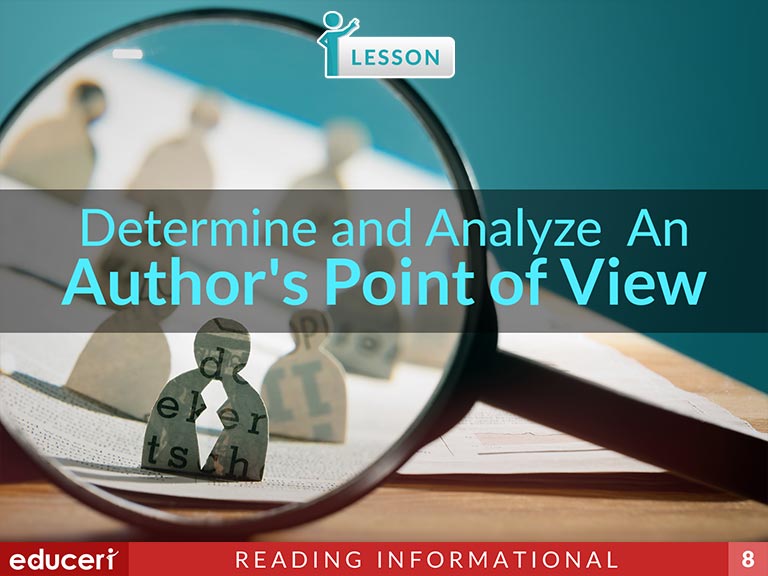
Determine and Analyze an Author's Point of View
This reading comprehension lesson focuses on identifying an authors point of view. The lesson includes research-based strategies and strategic questions that prepare students for assessments. In this lesson, students read the passage to determine the author's point of view. Then, they go back to the text to identify supporting details that help develop the author's point of view. In addition to the lesson, there are four pages of Independent Practice and review with questions modeled after current adaptive testing items.
Share This Lesson
Determine the Figurative Meaning of Words in Informational Text
Share This Lesson
Identify Scope of Idea Between Text
Share This Lesson

Use Varied Sentence Openings
This writing conventions lesson focuses on using varied sentence openings. The lesson includes research-based strategies and strategic questions that prepare students for assessments. In this lesson, students read the passage and identify sentences that are repetitive. Then, they vary sentence opening by rewriting repetitive sentences using common sentence openings such as an -ly word, -ing phrase, or prepositional phrase. Finally, they answer questions about the personal style of the author that reflects on other sentence opening options. In addition to the lesson, there are four pages of Independent Practice and review modeled on current adaptive testing methods.
Share This Lesson

Write a Thesis Statement for Argumentative Text
This writing strategies lesson focuses on writing a coherent thesis statement. The lesson includes research-based strategies and strategic questions that prepare students for assessments. In this lesson, students identify the topic of the text and the controlling impression. Then, they read the remaining sentences to determine the author's reasoning as seen in supporting details. Finally, they combine the topic, controlling impression, and reasoning into a coherent thesis statement. In addition to the lesson, there are four pages of Independent Practice and review modeled on current adaptive testing methods.
Share This Lesson
Share This Lesson

Support a Thesis with Quotations and Paraphrasing
This writing strategies lesson focuses on supporting a thesis using quotations and paraphrasing. The lesson includes research-based strategies and strategic questions that prepare students for assessments. In this lesson, students read a given thesis based on a provided text. Then, they read the text, identifying quotations that support the thesis and paraphrasing other information that supports the thesis. Finally, they explain how the quotations and paraphrasing support the thesis. In addition to the lesson, there are four more articles and graphic organizers for Independent Practice and review modeled after current adaptive testing items.
Share This Lesson

Revise Writing for Appropriate Word Choice
This writing strategies lesson focuses on revising writing for appropriate word choice. The lesson includes research-based strategies and strategic questions that prepare students for assessments. In this lesson, students read the question and the paragraph looking for the underline word to be revised. Then, they determine a more appropriate word to replace the underlined word, using a word bank of necessary. Finally, they reread the sentence with the new word to check. In addition to the lesson, there are four more pages for Independent Practice and review modeled after current adaptive testing items.
Share This Lesson
Revise Writing to Use Effective Transitions Between Paragraphs
This writing strategies lesson focuses on revising writing to use effective transitions between paragraphs. The lesson includes research-based strategies and strategic questions that prepare students for assessments. In this lesson, students read the paragraph and identify any details that have a common idea and would suggest the main idea. Then, they determine the main idea of each paragraph. Finally, they determine the relationship between the paragraphs and select an effective transition sentence from the choices given. In addition to the lesson, there are four more pages for Independent Practice and review modeled after current adaptive testing items.
Share This Lesson
Create a Composition
This writing strategies lesson focuses on creating a composition. The lesson includes research-based strategies and strategic questions that prepare students for assessments. In this lesson, students choose a topic and write their controlling impression (their opinion). Then, they research to find three broad reasons for that support their impression. Then, they write the thesis statement with a controlling impression, followed by elaboration on the reasons in the body, and a summary or final appeal for the conclusion. In addition to the lesson, there are three more graphic organizers for planning and writing the composition as well as a page of possible topics.
Share This Lesson

Revise Writing for Consistent Point of View
This writing strategies lesson focuses on revising writing from a consistent point of view. The lesson includes research-based strategies and strategic questions that prepare students for assessments. In this lesson, students read the passage and underline all pronouns used. Then, they determine if the first, second, or third person is used in each sentence. Then, they identify any sentences that use an inconsistent point of view and rewrite it. Finally, they reread the passage as revised and explain how this change maintains a consistent point of view. In addition to the lesson, there are four more pages for Independent Practice and review modeled after current adaptive testing items.
Share This Lesson
Write Informative Text
This writing lesson covers how to write informative text. The lesson includes research-based strategies and strategic questions that prepare students for assessments. In this lesson, students write at least one complete sentence for each section of the planning chart completed in the Plan Informative Text lesson. Then, they use an editing checklist to identify and correct any errors. In addition to the lesson, there are four pages of topics for review and extended thinking.
Share This Lesson