
All Lessons
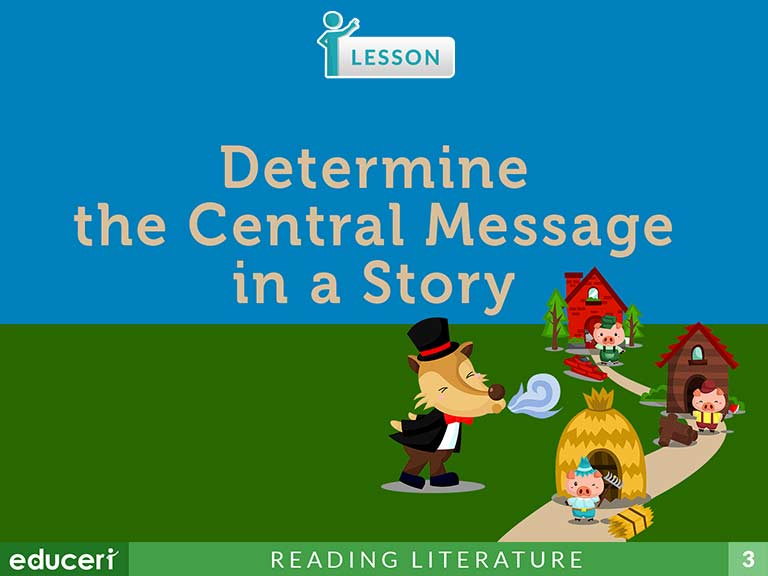
Determine the Central Message in a Story
- Grade:
- 3
- Subject:
- English Language Arts
This reading literature lesson explains how to determine the central message of a text. In this lesson, students will discuss the main events of a text and choose which of several possible sentences would best show the central message.
Determine Plots of Legends
- Grade:
- 3
- Subject:
- English Language Arts
This literary response and analysis lesson focuses on determining plots of legends. The lesson includes research-based strategies and strategic questions that prepare students for assessments. In this lesson, students use the characteristics of legends (a real/imaginary hero, exaggerated details, etc.) to comprehend the plot of legends. In addition to the lesson, there are four pages of Independent Practice and review with questions modeled after current adaptive testing items.
Distinguish Between the Character's Point of View and Our Own
- Grade:
- 3
- Subject:
- English Language Arts
In this Reading Literature lesson, students distinguish between what a character thinks and feels and their own thoughts and feelings on the story. The lesson includes research-based strategies and strategic questions that prepare students for assessments. In addition to the lesson, there are eight pages of Independent Practice and review with questions modeled after current adaptive testing items.
Read and Comprehend Informational Text by Answering Questions about Topic
- Grade:
- 3
- Subject:
- English Language Arts
Read and Interpret Informational Text by Answering Where, When or How Questions
- Grade:
- 3
- Subject:
- English Language Arts
This reading information text lesson focuses on reading and interpreting. In this lesson, students will answer where, when, and how questions about a text. The lesson includes research-based strategies and strategic questions that prepare students for assessments. (Also aligns with 3.RI.1.)
Describe Time Relationships in Text (Chronological Order)
- Grade:
- 3
- Subject:
- English Language Arts
This reading informational text lesson focuses on time relationships in text. The lesson includes research-based strategies and strategic questions that prepare students for assessments. In this lesson, students will identify time clue words (month, day, year, time, age) and then identify the time order of events in a text.
Determine Sequential Order in Text
- Grade:
- 3
- Subject:
- English Language Arts
This reading informational text lesson that describes the sequence relationships between ideas in a text. The lesson includes research-based strategies and strategic questions that prepare students for assessments. In this lesson, students will identify clue words (such as, first, last, next, etc.) and then answer questions that determine the relationship between ideas.
Follow Multiple-Step Written Instructions
- Grade:
- 3
- Subject:
- English Language Arts
This reading comprehension lesson focuses on following multiple-step written instructions. The lesson includes research-based strategies and strategic questions that prepare students for assessments. In this lesson, students use directions containing more than one step to answer questions about how to make or do something. In addition to the lesson, there are four pages of Independent Practice and review with questions modeled after current adaptive testing items.
Use Text Features to Locate Information
- Grade:
- 3
- Subject:
- English Language Arts
This reading comprehension lesson focuses on using chapter headings to locate information. The lesson includes research-based strategies and strategic questions that prepare students for assessments. In this lesson, students use chapter headings and subheadings to locate information in a table of contents or text passage. In addition to the lesson, there are five pages of Independent Practice and review with questions modeled after current adaptive testing items.
Answer Questions Referring to the Text
- Grade:
- 3
- Subject:
- English Language Arts
This Common Core reading informational text lesson focuses on reading comprehension. The lesson includes research-based strategies and strategic questions that prepare students for Common Core assessments. In this lesson, students will answer questions to demonstrate an understanding of a text, referring explicitly to the text as the basis for the answers. In addition to the lesson, there are four pages of Independent Practice and review with questions modeled after the Common Core assessment items.
Describe Cause & Effect Relationships
- Grade:
- 3
- Subject:
- English Language Arts
This reading comprehension lesson focuses on describing the relationship between cause and effect. The lesson includes research-based strategies and strategic questions that prepare students for assessments. In this lesson, students use clues from the text they read, as well as prior knowledge to determine which event is the cause and which is the effect. In addition to the lesson, there are four pages of Independent Practice and review with questions modeled after current adaptive testing items.
Describe Text Using Information From Illustrations and Words
- Grade:
- 3
- Subject:
- English Language Arts
This reading informational text lesson explains how pictures add information to a text. In this lesson, students will describe where particular kinds of information are located within a text and its illustrations.
Distinguish Between the Author's Point of View and Our Own
- Grade:
- 3
- Subject:
- English Language Arts
This reading informational text lesson focuses on distinguishing between the author's point of view and our own. The lesson includes research-based strategies and strategic questions that prepare students for assessments.
Plan and Write an Opinion Piece
- Grade:
- 3
- Subject:
- English Language Arts
This writing lesson focuses on writing an opinion piece. In this lesson, students will introduce a topic or text, state their opinion, and create an organizational structure that lists appropriate reasons. (Also aligns to standard 3.W.1b.)