All Lessons
Flashcards Form and Use Comparative and Superlative Adjectives (Irregular)
- Grade:
- 3
- Subject:
- English Language Arts
Flashcards Form and Use Comparative and Superlative Adjectives
- Grade:
- 3
- Subject:
- English Language Arts
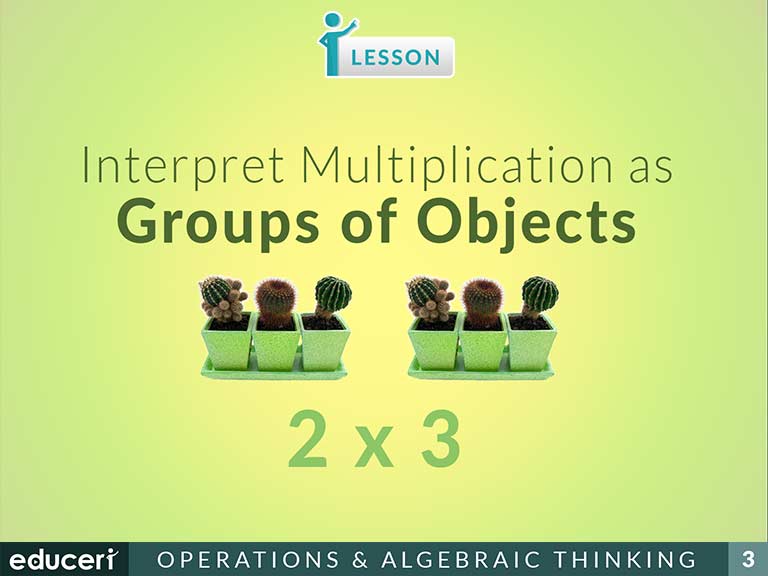
Interpret Multiplication as Groups of Objects
- Grade:
- 3
- Subject:
- Math
This operations and algebraic thinking lesson covers how to interpret multiplication as repeated addition of groups of equal amounts. The lesson includes research-based strategies and strategic questions that prepare students for assessments. In this lesson, students will examine word and picture problems to determine the number of groups and amount in each group. Then, they will select or create which situation can be solved using given multiplication statements.
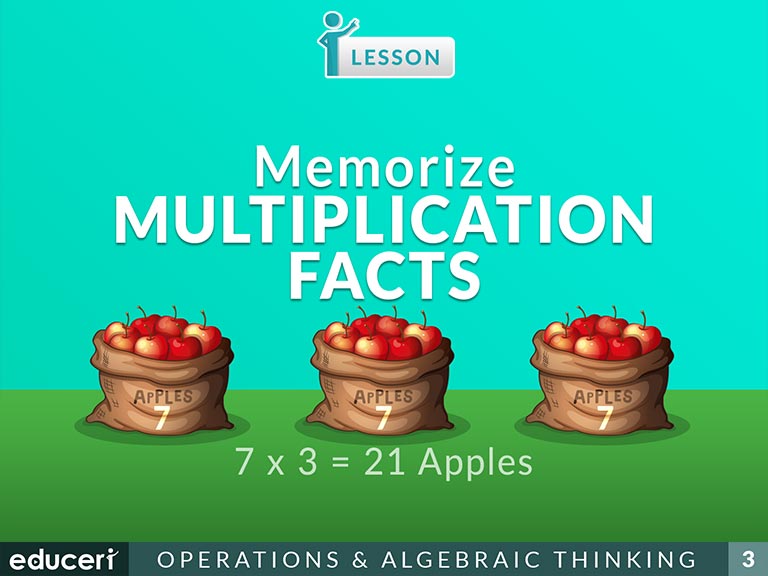
Memorize Multiplication Facts
- Grade:
- 3
- Subject:
- Math
This operations and algebraic thinking lesson covers how to memorize multiplication facts. The lesson includes research-based strategies and strategic questions that prepare students for assessments. In this lesson, students will practice the multiplication facts of numbers 2 through 10 by a combination of reading aloud and writing each fact many times in horizontal and vertical formats.
Memorize the Multiplication Facts for 2
- Grade:
- 3
- Subject:
- Math
This number sense lesson focuses on memorizing multiplication facts for 2. The lesson includes research-based strategies and questions that help prepare students for assessments. In this lesson, students practice reading aloud, writing/filling in the product, and writing the entire multiplication fact for the number 2. In addition to the lesson, there are four pages of Independent Practice and review with questions modeled after current adaptive testing items.
Memorize the Multiplication Facts for 5
- Grade:
- 3
- Subject:
- Math
This number sense lesson focuses on memorizing multiplication facts for 5. The lesson includes research-based strategies and questions that help prepare students for assessments. In this lesson, students practice reading aloud, writing/filling in the product, and writing the entire multiplication fact for the number 5. In addition to the lesson, there are four pages of Independent Practice and review with questions modeled after current adaptive testing items.
Memorize the Multiplication Facts for 10
- Grade:
- 3
- Subject:
- Math
This number sense lesson focuses on memorizing multiplication facts for 10. The lesson includes research-based strategies and questions that help prepare students for assessments. In this lesson, students practice reading aloud, writing/filling in the product, and writing the entire multiplication fact for the number 10. In addition to the lesson, there are four pages of Independent Practice and review with questions modeled after current adaptive testing items.
Use the Associative Property of Multiplication
- Grade:
- 3
- Subject:
- Math
This algebra and functions lesson focuses on using the associative property of multiplication. The lesson includes research-based strategies and questions that help prepare students for assessments. In this lesson, students multiply the first two factors in column A, then multiply that product by the remaining factor. Then, they repeat they repeat the steps for column B. Finally, students compare the final products in column A and B. In addition to the lesson, there are four pages of Independent Practice and review with questions modeled after current adaptive testing items.

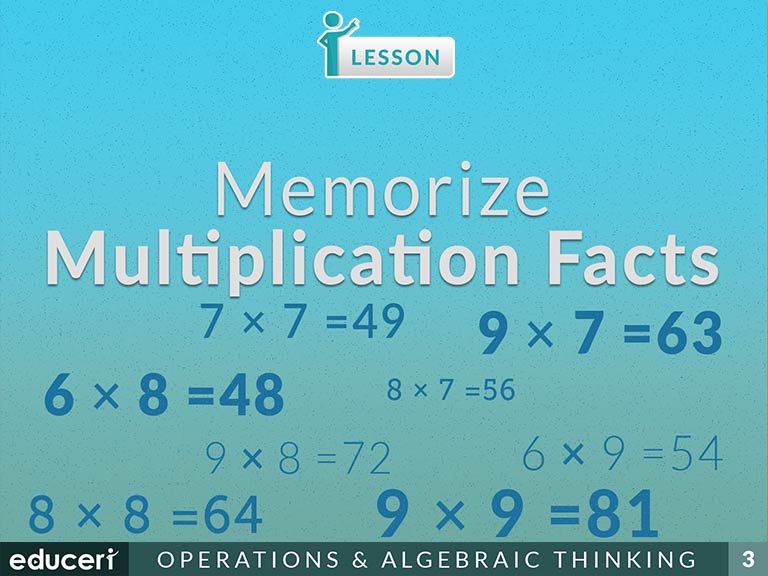
Memorize Multiplication Facts (Products over 45)
- Grade:
- 3
- Subject:
- Math
This Common Core operations and algebraic thinking lesson covers how to memorize multiplication facts. The lesson includes research-based strategies and strategic questions that prepare students for Common Core assessments. In this lesson, students will practice the multiplication facts of numbers with products over 45 by a combination of reading aloud and writing each fact many times in horizontal and vertical formats. In addition to the lesson, Independent Practice provides practice with random problems for each number, while periodic review provides practice with random problems for all the numbers together. The intent of this lesson is to provide additional practice for the multiplication facts that are more difficult for students to remember.
Solve Two-Step Word Problems (Addition & Subtraction)
- Grade:
- 3
- Subject:
- Math
Solve two-step word problems using addition and subtraction. Represent these problems using equations with a letter standing for the unknown quantity. Assess the reasonableness of answers using mental computation and estimation strategies including rounding.
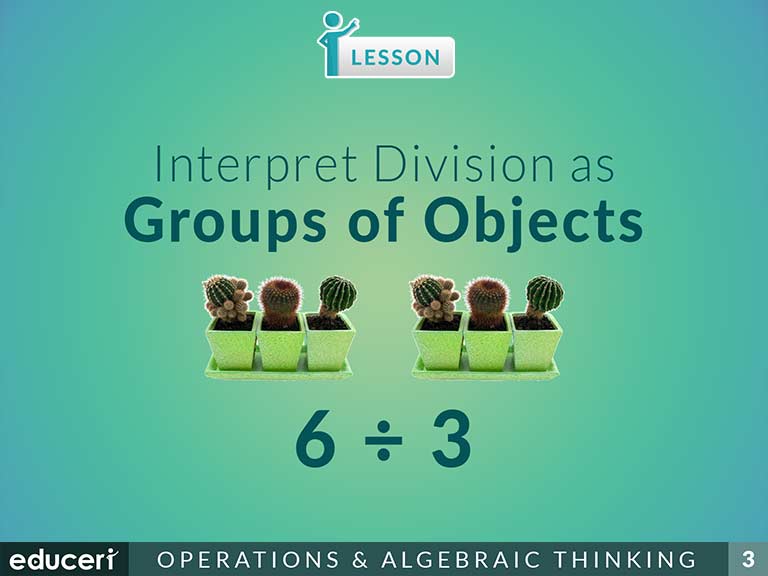
Interpret Division as Groups of Objects
- Grade:
- 3
- Subject:
- Math
Interpret whole-number quotients of whole numbers, e.g., interpret 56 ÷ 8 as the number of objects in each share when 56 objects are partitioned equally into 8 shares, or as a number of shares when 56 objects are partitioned into equal shares of 8 objects each. For example, describe a context in which a number of shares or a number of groups can be expressed as 56 ÷ 8.