
All Lessons
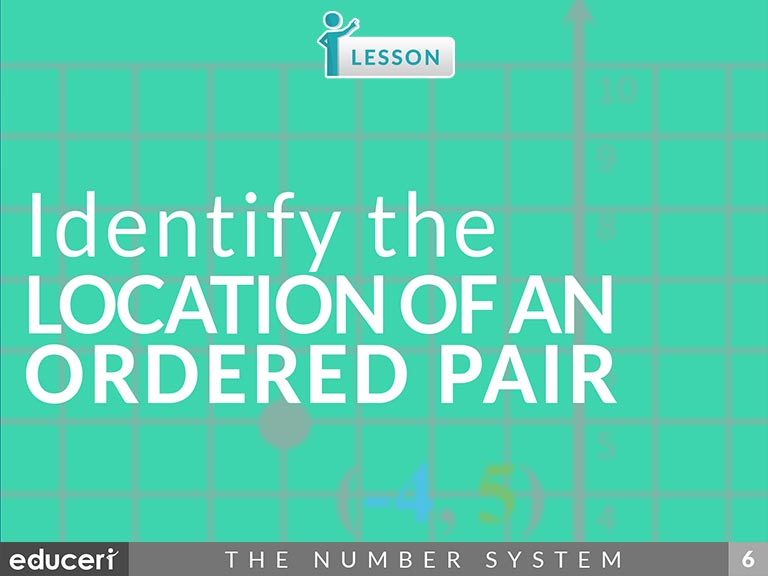
Identify the Location of an Ordered Pair
- Grade:
- 6
- Subject:
- Math
This number system lesson teaches students how to identify the location of an ordered pair. The lesson includes research-based strategies and strategic questions that prepare students for assessments. In this lesson, students will identify the location of ordered pairs on the coordinate plane. This lesson includes plotting numbers on all four quadrants of the coordinate plane.
Describe Positive & Negative Numbers
- Grade:
- 6
- Subject:
- Math
This number system lesson teaches students how to describe positive and negative numbers. The lesson includes research-based strategies and strategic questions that prepare students for assessments. In this lesson, students will be introduced to negative numbers. Students will begin to develop a sense of what negative numbers mean.
Order Fractions and Mixed Numbers on a Number Line
- Grade:
- 6
- Subject:
- Math
This number sense lesson focuses on ordering fractions and mixed numbers on a number line. The lesson includes research-based strategies and strategic questions that prepare students for assessments. In this lesson, students place each fraction or mixed number (from a group of four) on the number line one at a time by reading each number aloud, determining the sign and value of the whole number or fraction, and determining the denominator and numerator. Finally, they order the numbers from least to greatest or greatest to least using the number line. In addition to the lesson, there are sixteen pages of Independent Practice and Periodic Reviews with questions modeled after current adaptive testing items.
Reduce Fractions (Using the Greatest Common Factor)
- Grade:
- 6
- Subject:
- Math
This number sense lesson focuses on reducing fractions. The lesson includes research-based strategies and strategic questions that prepare students for assessments. In this lesson, students find the factors of the numerator and denominator. Then, they identify the greatest common factor (GCF) and write it down. Finally, they reduce the fraction by dividing the numerator and denominator by the GCF and interpreting the reduced fraction. In addition to the lesson, there are five pages of Independent Practice and Periodic Reviews with questions modeled after current adaptive testing items and 10 flashcards for reduced fractions.
Plot Points on a Coordinate Plane
- Grade:
- 6
- Subject:
- Math
This geometry lesson covers how to plot an ordered pair on a coordinate plane. The lesson includes research-based strategies and strategic questions that prepare students for assessments. In this lesson, students will learn how to determine the x-coordinate and the y-coordinate, and then plot the coordinates on the grid.
Write Numerical Expressions Using Exponential Form
- Grade:
- 6
- Subject:
- Math
This expressions and equations lesson teaches students how to write numerical expressions using exponential form. The lesson includes research-based strategies and strategic questions that prepare students for assessments. In this lesson, students will use the exponential form to represent different values. Students will also relate exponents to place value and develop other conceptual understandings of what exponents are. This lesson does not cover evaluating expressions with exponents.
Use a Variable to Write an Algebraic Expression
- Grade:
- 6
- Subject:
- Math
This algebra and functions lesson focuses on using a variable to write an algebraic expression. The lesson includes research-based strategies and strategic questions that prepare students for assessments. In this lesson, students read the problem, identifying the unknown amount, the given number or known amount, and the operation (using clue words or actions such as sum, difference, product, or quotient). Then, they write the algebraic expression. In addition to the lesson, there are eight pages of Independent Practice and review with questions modeled after current adaptive testing items.
Analyze the Relationship Between Dependent and Independent Variables
- Grade:
- 6
- Subject:
- Math
This algebra and functions lesson focuses on writing the equation of a linear function. The lesson includes research-based strategies and strategic questions that prepare students for assessments. In this lesson, students identify each rule that could be applied to the x-value and result in the y-value. Then, they verify which rule is true by testing each on the next x-value in the table. Finally, they select the rule that makes the function true. In addition to the lesson, there are sixteen pages of Independent Practice and Periodic Reviews with questions modeled after current adaptive testing items.
Evaluate Numerical Expressions Involving Exponents
- Grade:
- 6
- Subject:
- Math
This number sense lesson focuses on computing exponents. The lesson includes research-based strategies and strategic questions that prepare students for assessments. In this lesson, students read the problem, identifying the base and the exponent. Then, they rewrite the exponent as a repeated multiplication, find the product, and interpret it. In addition to the lesson, there are nine pages of Independent Practice and Periodic Reviews with questions modeled after current adaptive testing items.
Use Order of Operations
- Grade:
- 6
- Subject:
- Math
This algebra and functions lesson focuses on using the order of operations. The lesson includes research-based strategies and strategic questions that prepare students for assessments. In this lesson, students determine which operation to perform first (using PEMDAS) and repeat the order of operations until no more can be performed. Then, they compute the final value. In addition to the lesson, there are thirteen pages of Independent Practice and Periodic Reviews with questions modeled after current adaptive testing items.
Write Equations
- Grade:
- 6
- Subject:
- Math
This algebra and functions lesson focuses on writing equations. The lesson includes research-based strategies and strategic questions that prepare students for assessments. In this lesson, students read the written sentence and identify the variable and known amounts as well as the operation clue words. Then, they determine where the equal sign will be written, interpret the written description to write the equation, and read the equation aloud. In addition to the lesson, there are five pages of Independent Practice and review with questions modeled after current adaptive testing items. EE.2.A. E.E.2A E.E.2.A.