
All Lessons
Verify the Solution to an Equation
- Grade:
- 7
- Subject:
- Math
This expressions and equations lesson teaches students how to verify the solution to an equation. The lesson includes research-based strategies and strategic questions that prepare students for assessments. In this lesson, students substitute a given value for a variable to determine whether or not the value is a solution.
Construct Triangles
- Grade:
- 7
- Subject:
- Math
This geometry lesson covers how to construct triangles using a ruler, protractor, and compass. The lesson includes research-based strategies and strategic questions that prepare students for assessments. In this lesson, the teacher constructs the triangle with the given conditions, labeling the sides and angles. Then, students do a different construction of the same triangle, and check it by measuring the three side lengths and angles. An animated demonstration is provided.
Solve Problems for the Area & Circumference of a Circle
- Grade:
- 7
- Subject:
- Math
This geometry lesson covers how to solve problems for the area and circumference of a circle. The lesson includes research-based strategies and strategic questions that prepare students for assessments. In this lesson, students identify the given information and determine which formula to use. Then, they substitute the given information into the formula and solve. Finally, they interpret the answer.
Solve For An Unknown Angle Using Properties of Angles
- Grade:
- 7
- Subject:
- Math
This geometry lesson covers how to solve for unknown angle measures using properties of angles. The lesson includes research-based strategies and strategic questions that prepare students for assessments. In this lesson, students determine the property of angles needed, then substitute the given angle measures into the equation and solve it. Finally, they write the solution using the angle measure and degree symbol.
Compute the Area of Irregular (Composed) Two-Dimensional Figures
- Grade:
- 7
- Subject:
- Math
This measurement and geometry lesson focuses on computing the area of irregular two-dimensional figures. The lesson includes research-based strategies and strategic questions that prepare students for assessments. In this lesson, students divide the irregular figure into common shapes, such as triangles and rectangle or circles. Then, they compute the areas of the common shapes and the sum of all the areas. In addition to the lesson, there are six pages of Independent Practice and review with questions modeled after current adaptive testing items.
Compute Perimeter and Area of Two-Dimensional Figures
- Grade:
- 7
- Subject:
- Math
This measurement and geometry lesson focuses on computing the perimeter and area of two-dimensional figures. The lesson includes research-based strategies and strategic questions that prepare students for assessments. In this lesson, students read the problem and circle whether you are solving for perimeter, circumference, or area. Then, write the formula needed to solve the problem. Finally, substitute the known values into the formula and solve the equation. In addition to the lesson, there are six pages of Independent Practice and review with questions modeled after current adaptive testing items.
Solve Problems Involving Surface Area of Three-Dimensional Objects
- Grade:
- 7
- Subject:
- Math
This geometry lesson teaches students how to calculate the surface area of rectangular prisms. The lesson includes research-based strategies and strategic questions that prepare students for assessments. In this lesson, students will solve problems involving the surface area of rectangular prisms.
Use The Triangle Inequality Theorem to Determine Possible Triangles
- Grade:
- 7
- Subject:
- Math
This math lesson teaches students how to use the Triangle Inequality theorem to determine the possible range of values for an unknown side of a triangle. The lesson includes research-based strategies and strategic questions that prepare students for standardized assessments. In this lesson, students will calculate the sum and difference of the two known sides of the triangle and recognize that the unknown side must have a value between the two. In addition to the lesson, there are two pages of independent practice and nine pages of periodic review with questions modeled after standardized assessments.
Represent Outcomes for Compound Events
- Grade:
- 7
- Subject:
- Math
This statistics, data analysis, and probability lesson focuses on representing outcomes for compound events. The lesson includes research-based strategies and strategic questions that prepare students for assessments. In this lesson, students read the question and identify the desired outcome. Then, they use a tree diagram or table to determine the outcomes. Finally, they list all the outcomes for the compound event, identify the desired outcomes, and set up a fraction to determine the probability of the event. In addition to the lesson, there are eight pages of Independent Practice and review with questions modeled after current adaptive testing items.
Methods of Sampling (Random, Convenience, Self-Selected)
- Grade:
- 7
- Subject:
- Math
This statistics, data analysis, and probability lesson focuses on identifying different ways of selecting a sample. The lesson includes research-based strategies and strategic questions that prepare students for assessments. In this lesson, students read the scenario, noting clues that help to identify the sampling method. Then, they identify the sampling method used in the survey (random, convenience, or self-selected), and explain how they know. In addition to the lesson, there are four pages of Independent Practice and review with questions modeled after current adaptive testing items.
Represent Probability as Ratios & Percentages
- Grade:
- 7
- Subject:
- Math
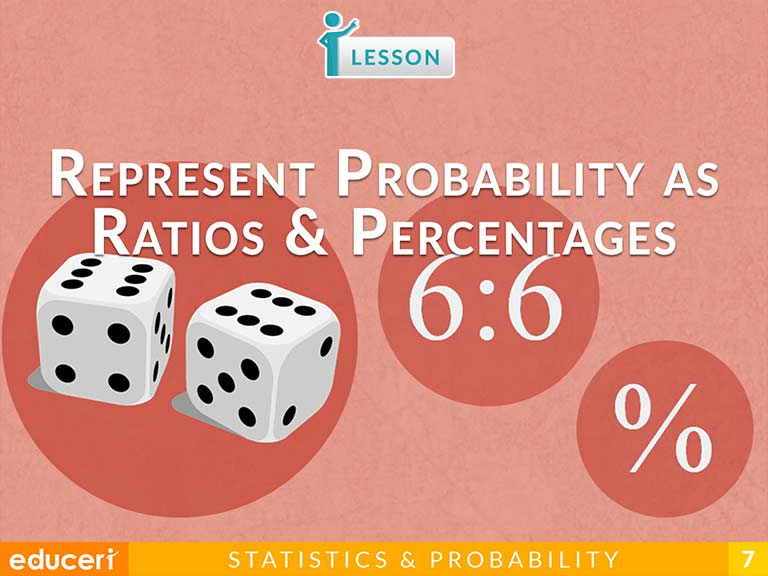
This statistics, data analysis, and probability lesson focuses on representing probability as ratios and percentages. The lesson includes research-based strategies and strategic questions that prepare students for assessments. In this lesson, students read the question and identify what probability they are looking for. Then, they write the number of ways the event can occur and determine the number of total outcomes. Finally, they write the probability as a ratio and reduce, if needed, and then write it as a percentage. In addition to the lesson, there are five pages of Independent Practice and review with questions modeled after current adaptive testing items.
Missouri Learning Standards ELA (7th Grade)
- Grade:
- 7
- Subject:
- English Language Arts, Other Resources
New York Learning Objectives ELA (7th Grade)
- Grade:
- 7
- Subject:
- English Language Arts, Other Resources