Lessons tagged with "difference"
Subtract Two-Digit Numbers (With Decomposing)
- Grade:
- 2
- Subject:
- Math
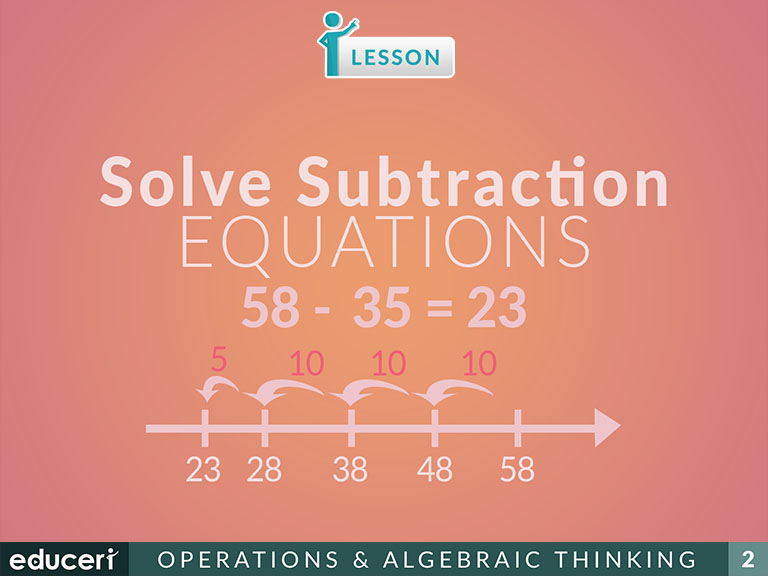
This number sense lesson focuses on subtracting numbers (two digits long). The lesson includes research-based strategies and questions that help prepare students for assessments. In this lesson, students determine if regrouping is needed. Then, they subtract digits in the ones place, and in the tens place. Finally, students read the problem and sum aloud. In addition to the lesson, there are "lining up subtraction" flashcards along with seven pages of Independent Practice and review with questions modeled after current adaptive testing items.
Subtract Multi-Digit Numbers With Decomposing
- Grade:
- 3
- Subject:
- Math
This lesson covers how to subtract numbers with decomposing. The lesson includes research-based strategies and strategic questions that prepare students for assessments. In this lesson, students will line up the numbers by place value of their digits, subtract the digits in each place value, decompose the number (if needed), and then interpret the difference. In addition to the lesson, there are four pages of Independent Practice with questions modeled after the assessment items.
Add & Subtract Time Intervals
- Grade:
- 3
- Subject:
- Math
This measurement and data lesson covers how to solve problems involving the adding and subtracting of time intervals. The lesson includes research-based strategies and strategic questions that prepare students for assessments. In this lesson, students will identify the time intervals in a word problem, determine whether to add or subtract, and then perform the operation and interpret the result.
Subtract Whole Numbers (Standard Algorithm)
- Grade:
- 4
- Subject:
- Math
This number sense lesson focuses on subtracting whole numbers. The lesson includes research-based strategies and questions that help prepare students for assessments. In this lesson, students read the subtraction problem and line up the numbers by their place value. Then, they subtract each column (starting from the right) and regroup, if needed. Finally, students interpret the difference. In addition to the lesson, there are four pages of Independent Practice and review with questions modeled after current adaptive testing items.
Subtract Decimal Numbers
- Grade:
- 5
- Subject:
- Math
This number sense lesson focuses on subtracting decimal numbers. The lesson includes research-based strategies and strategic questions that prepare students for assessments. In this lesson, students identify the numbers that are being subtracted, if needed. Then, they line up the decimal numbers by place value, making sure the decimal points line up. Finally, they subtract, line up the decimal point in the difference, and interpret the difference. In addition to the lesson, there are eight pages of Independent Practice and review with questions modeled after current adaptive testing items.
Find the Length of a Horizontal Line Segment
- Grade:
- 5
- Subject:
- Math
This measurement and geometry lesson focuses on finding the length of a horizontal line segment. The lesson includes research-based strategies and questions that help prepare students for assessments. In this lesson, students identify the x-coordinate in each ordered pair. Then, they find the length of the horizontal line segment by calculating the difference of the x-coordinates. Finally, they interpret their solution. In addition to the lesson, there are four pages of Independent Practice and review with questions modeled after current adaptive testing items.
Use a Variable to Write an Algebraic Expression
- Grade:
- 6
- Subject:
- Math
This algebra and functions lesson focuses on using a variable to write an algebraic expression. The lesson includes research-based strategies and strategic questions that prepare students for assessments. In this lesson, students read the problem, identifying the unknown amount, the given number or known amount, and the operation (using clue words or actions such as sum, difference, product, or quotient). Then, they write the algebraic expression. In addition to the lesson, there are eight pages of Independent Practice and review with questions modeled after current adaptive testing items.
Use The Triangle Inequality Theorem to Determine Possible Triangles
- Grade:
- 7
- Subject:
- Math
This math lesson teaches students how to use the Triangle Inequality theorem to determine the possible range of values for an unknown side of a triangle. The lesson includes research-based strategies and strategic questions that prepare students for standardized assessments. In this lesson, students will calculate the sum and difference of the two known sides of the triangle and recognize that the unknown side must have a value between the two. In addition to the lesson, there are two pages of independent practice and nine pages of periodic review with questions modeled after standardized assessments.