Lessons tagged with "divide"

Use the Relationship Between Multiplication & Division
- Grade:
- 4
- Subject:
- Math
This number sense lesson focuses on using the relationship between multiplication and division to check answers. The lesson includes research-based strategies and questions that help prepare students for assessments. In this lesson, students identify the operation needed to check the answer. Then, they set up the multiplication or division problem and identify the numbers used to create the problem. Finally, students check the answer by solving the problem. In addition to the lesson, there are four pages of Independent Practice and review with questions modeled after current adaptive testing items.
Divide to Determine the Unit Cost
- Grade:
- 4
- Subject:
- Math
This number sense lesson focuses on determining the unit cost. The lesson includes research-based strategies and questions that help prepare students for assessments. In this lesson, students read the problem and identify the number of units and the total cost. Then, they set up the division problem using the number of units and total cost, and solve the division problem. In addition to the lesson, there are eight pages of Independent Practice and review with questions modeled after current adaptive testing items.
Divide Multi-Digit Numbers By a One-Digit Number (with Remainders)
- Grade:
- 4
- Subject:
- Math
This number sense lesson focuses on solving division problems that have a remainder. The lesson includes research-based strategies and questions that help prepare students for assessments. In this lesson, students identify the dividend and the divisor. Then, they solve for the division problem by following the basic steps of division (divide, multiply, subtract, and bring down) and writing in the remainder. Finally, students interpret the quotient and remainder. In addition to the lesson, there are eight pages of Independent Practice and review with questions modeled after current adaptive testing items.
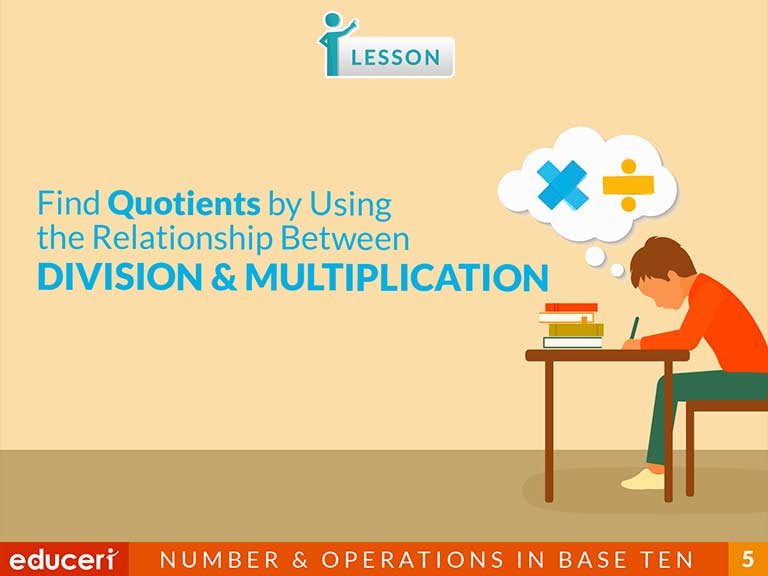
Find Quotients by Using the Relationship Between Division & Multiplication
- Grade:
- 5
- Subject:
- Math
This number and operations in base ten lesson teaches students how to use the relationship between division and multiplication to solve division problems. The lesson includes research-based strategies and strategic questions that prepare students for assessments. In this lesson, students rewrite division problems as multiplication problems as a strategy to help find quotients. This lesson should be considered an initial first step to more complex division problems. By using multiples of 10 and 100, students are able to see the structure of what is going on without getting distracted by difficult calculation.
Divide Decimal Numbers
- Grade:
- 5
- Subject:
- Math
This number sense lesson focuses on dividing decimal numbers. The lesson includes research-based strategies and strategic questions that prepare students for assessments. In this lesson, students change the problem into long division form, if necessary, and move the decimal point in the divisor to change it to a whole number, if necessary. Then, move the decimal point in the dividend the same number of places. Finally, they divide the decimal numbers and put a decimal point in the quotient above the decimal point in the dividend. In addition to the lesson, there are four pages of Independent Practice and Periodic Reviews with questions modeled after current adaptive testing items and eight flash cards on changing to long division form.
Divide Unit Fractions by Whole Numbers
- Grade:
- 5
- Subject:
- Math
This lesson focuses on the fluency of dividing a unit fraction by a whole number. Although the purpose of the lesson is to teach the process, there are opportunities for students to conceptually examine, read, and write about the structure of a unit fraction being divided by a whole number.
Evaluate Numerical Expressions
- Grade:
- 6
- Subject:
- Math
This equations and expressions lesson teaches students how to evaluate numerical expressions. The lesson includes research-based strategies and strategic questions that prepare students for assessments. In this lesson, students evaluate numerical expressions using the order of operations.
Solve Problems Involving Proportional Relationships
- Grade:
- 6
- Subject:
- Math
This ratios and proportional relationships lesson teaches students how to solve problems involving proportional relationships. The lesson includes research-based strategies and strategic questions that prepare students for assessments. In this lesson, students will identify a given ratio in a word problem, then the unknown ratio. They will represent the proportional relationship in a table and generate an equivalent ratio to solve for the unknown. Finally, they will interpret the solution.
Evaluate Algebraic Expressions Using Substitution (Exponents 2 of 2)
- Grade:
- 6
- Subject:
- Math
This algebra and functions lesson focuses on evaluating expressions by using the order of operations. The lesson includes research-based strategies and strategic questions that prepare students for assessments. In this lesson, students substitute the given value of each variable into the expression. Then, they evaluate the expression by determining which operation to perform first (using PEMDAS) and repeating the order until no more operations can be performed. Finally, they compute the value and interpret the answer. In addition to the lesson, there are four pages of Independent Practice and review with questions modeled after current adaptive testing items and 12 flashcards for the order of operations.
Apply the Properties of Exponents
- Grade:
- 8
- Subject:
- Math
This expressions and equations lesson teaches students how to apply the properties of exponents. The lesson includes research-based strategies and strategic questions that prepare students for assessments. In this lesson, students will apply the properties of exponents to create equivalent expressions. There are flashcards for this lesson to review the concept that exponents must have the same base for multiplication and division to be used.
Divide a Polynomial by a Monomial
- Grade:
- High School, High School 9-10, High School 11-12
- Subject:
- Math
Factor Quadratic Expressions - Part 2
- Grade:
- High School, High School 9-10, High School 11-12
- Subject:
- Math
Simplify Expressions Using Exponential Rules
- Grade:
- High School, High School 9-10, High School 11-12
- Subject:
- Math
Divide a Polynomial by a Monomial
- Grade:
- High School, High School 9-10, High School 11-12
- Subject:
- Math
Simplify Expressions Using Exponential Rules
- Grade:
- High School, High School 9-10, High School 11-12
- Subject:
- Math
Factor Quadratic Expressions - Part 2
- Grade:
- High School, High School 9-10, High School 11-12
- Subject:
- Math
Factor Quadratic Expressions - Part 2
- Grade:
- High School, High School 9-10, High School 11-12
- Subject:
- Math
Divide a Polynomial by a Monomial
- Grade:
- High School, High School 9-10, High School 11-12
- Subject:
- Math
Simplify Expressions Using Exponential Rules
- Grade:
- High School, High School 9-10, High School 11-12
- Subject:
- Math
Rotation Stations (Two-Syllable Words & Other Activities)
- Grade:
- Subject:
- English Language Development
Rotation Stations (Two-Syllable Words with Prefixes and Suffixes & Other Activities)
- Grade:
- Subject:
- English Language Development
Rotation Stations (Two-Syllable Words & Other Activities)
- Grade:
- Subject:
- English Language Development