Lessons tagged with "equal"
Use the Equal Sign
- Grade:
- 1
- Subject:
- Math
This algebra and functions lesson focuses on using the equal sign. The lesson includes research-based strategies and questions that help prepare students for assessments. In this lesson, students read the problem and complete the math fact. Then, they determine whether the two numbers are equal or not equal using the appropriate symbols. Finally, students interpret the answer using the math fact. In addition to the lesson, there are four pages of equal sign flash cards and eight pages of Independent Practice and review with questions modeled after current adaptive testing items.
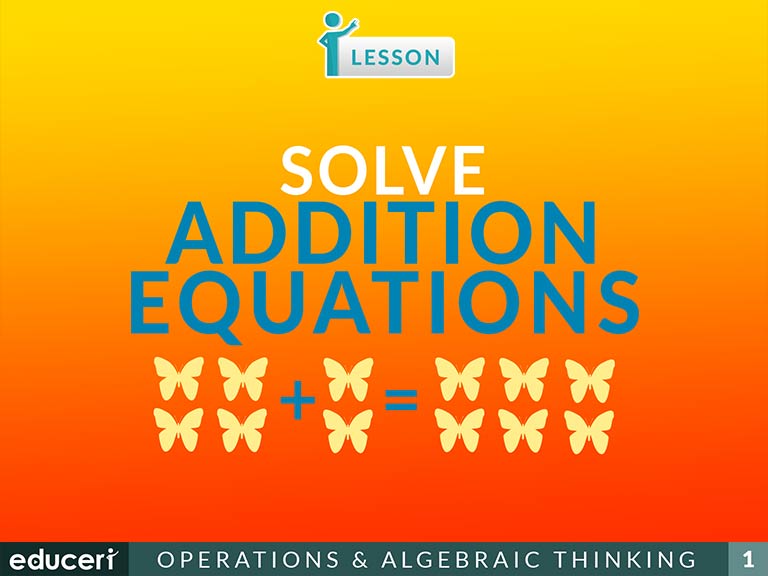
Solve Addition Equations
- Grade:
- 1
- Subject:
- Math
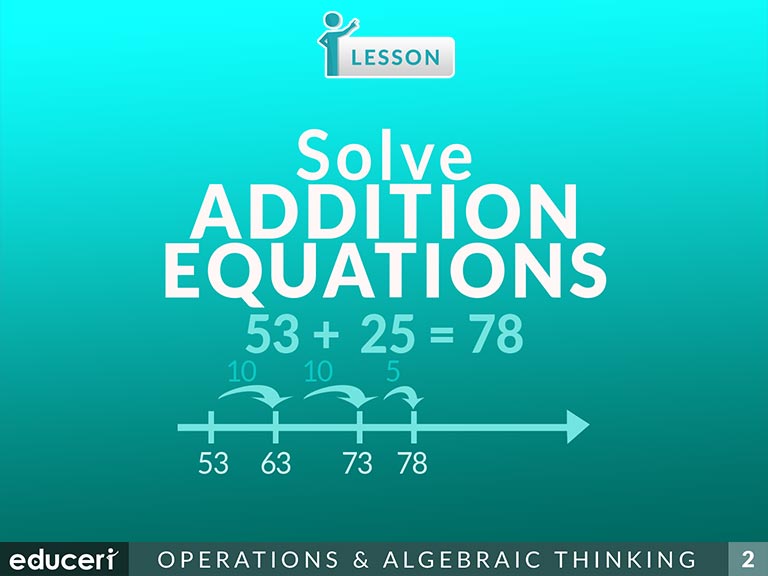
This algebra and functions lesson focuses on writing addition number sentences. The lesson includes research-based strategies and questions that help prepare students for assessments. In this lesson, students read the word problem and identify addition key words and number words. Then, they write an addition number sentence and practice reading aloud. In addition to the lesson, there are four pages of Independent Practice and review with questions modeled after current adaptive testing items.
Identify Equivalent Fractions
- Grade:
- 3
- Subject:
- Math
Recognize and generate simple equivalent fractions, e.g., 1/2 = 2/4, 4/6 = 2/3. Explain why the fractions are equivalent, e.g., by using a visual fraction model.
Express Whole Numbers as Fractions
- Grade:
- 3
- Subject:
- Math
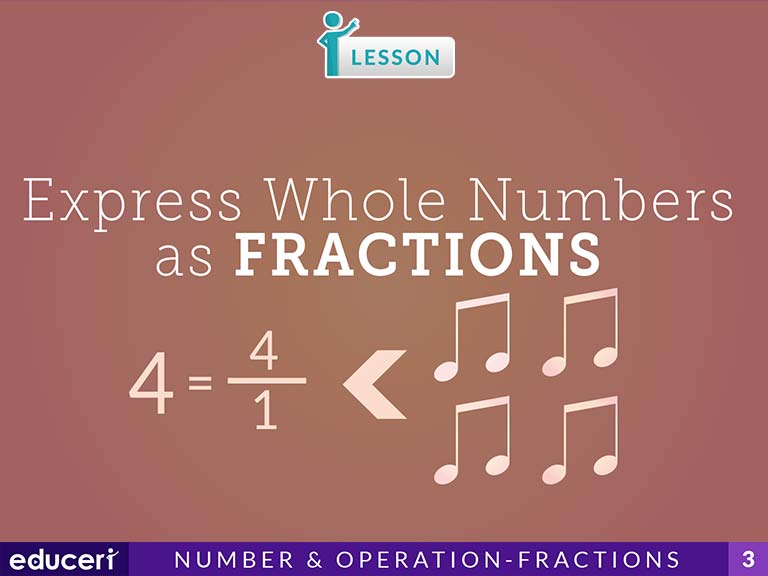
This numbers and operations − fractions lesson covers how to express whole numbers as fractions. The lesson includes research-based strategies and strategic questions that prepare students for assessments. In this lesson, students will count the whole items in a picture, write the whole number, and then express that whole number as a fraction.
Create Equivalent Fractions
- Grade:
- 3
- Subject:
- Math
Recognize and create simple equivalent fractions, e.g., 1/2 = 2/4, 4/6 = 2/3. Explain why the fractions are equivalent, e.g., by using a visual fraction model.
Generate Equivalent Fractions

- Grade:
- 4
- Subject:
- Math
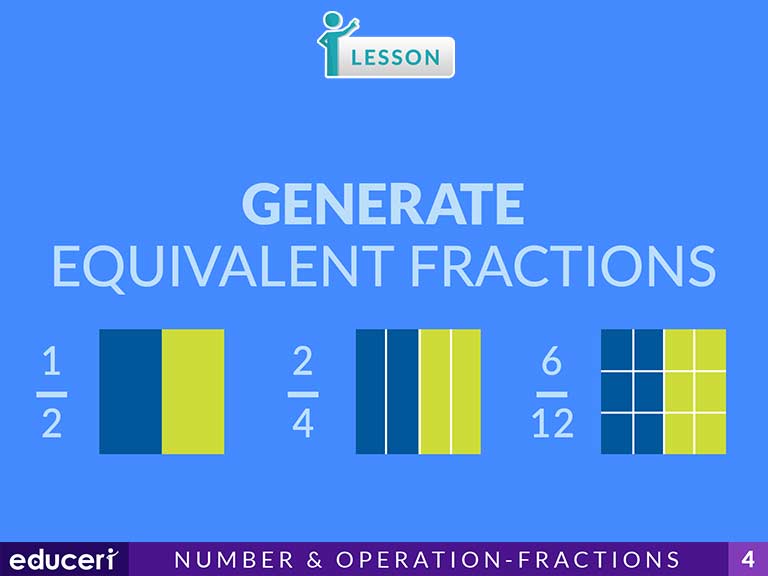
This number and operations--fractions lesson teaches students how to generate equivalent fractions. The lesson includes research-based strategies and strategic questions that prepare students for assessments. In this lesson, students will create equivalent fractions. This lesson focuses on changing a fraction to another. Students are provided a variety of strategies and support to visualize the equivalence. Real-world examples are also provided.
Classify Triangles by Their Attributes
- Grade:
- 4
- Subject:
- Math
This measurement and geometry lesson focuses on classifying triangles by their attributes. The lesson includes research-based strategies and questions that help prepare students for assessments. In this lesson, students identify equal sides on a triangle and classify the triangle by its sides. In addition to the lesson, there are triangle flashcards and four pages of Independent Practice and Periodic Reviews with questions modeled after current adaptive testing items.
Compare Multi-Digit Numbers
- Grade:
- 4
- Subject:
- Math
This number and operations in base ten lesson teaches students how to compare the value of multi-digit numbers. The lesson includes research-based strategies and strategic questions that prepare students for assessments. In this lesson, students determine which of a pair of multi-digit numbers is larger. The focus of this lesson is reinforcing differences between numbers based on place value.
Calculate the Area of a Rhombus
- Grade:
- 6
- Subject:
- Math
This math lesson teaches students how to calculate the area of a rhombus. The lesson includes research-based strategies and strategic questions that prepare students for standardized assessments. In this lesson, students will identify a rhombus and use one of two methods (the product of base and height or one-half the product of the diagonals) to calculate its area. In addition to the lesson, there are two pages of independent practice and three pages of periodic review with questions modeled after standardized assessments.
Solve Problems Involving Proportional Relationships
- Grade:
- 6
- Subject:
- Math
This ratios and proportional relationships lesson teaches students how to solve problems involving proportional relationships. The lesson includes research-based strategies and strategic questions that prepare students for assessments. In this lesson, students will identify a given ratio in a word problem, then the unknown ratio. They will represent the proportional relationship in a table and generate an equivalent ratio to solve for the unknown. Finally, they will interpret the solution.
Use Equation and Inequality Terminology (Inverse Operation, Solution, Verify)
- Grade:
- 6
- Subject:
- Math
This equations and expressions lesson covers the use of a variety of algebraic terminology. The lesson includes research-based strategies and strategic questions that prepare students for assessments. In this lesson, students describe the inverse operations required to solve algebraic equations.
Add & Subtract Expressions
- Grade:
- 7
- Subject:
- Math
This expressions and equations lesson covers how to add and subtract expressions. The lesson includes research-based strategies and strategic questions that prepare students for assessments. In this lesson, students will rewrite two grouped expressions as the sum of all terms, then identify like terms, and combine them. Finally, they will interpret the equivalent expressions.
Determine Similar Triangles
- Grade:
- High School
- Subject:
- Math
This math lesson teaches students how to use the Angle-Angle or the Equal Side Ratio theorem to determine if two triangles are similarity. The lesson includes research-based strategies and strategic questions that prepare students for standardized assessments. In this lesson, students will identify known information and determine which theorem applies, then use the theorem to prove the triangles' similarity. In addition to the lesson, there are two pages of independent practice and three pages of periodic review with questions modeled after standardized assessments.