Lessons tagged with "multiply"
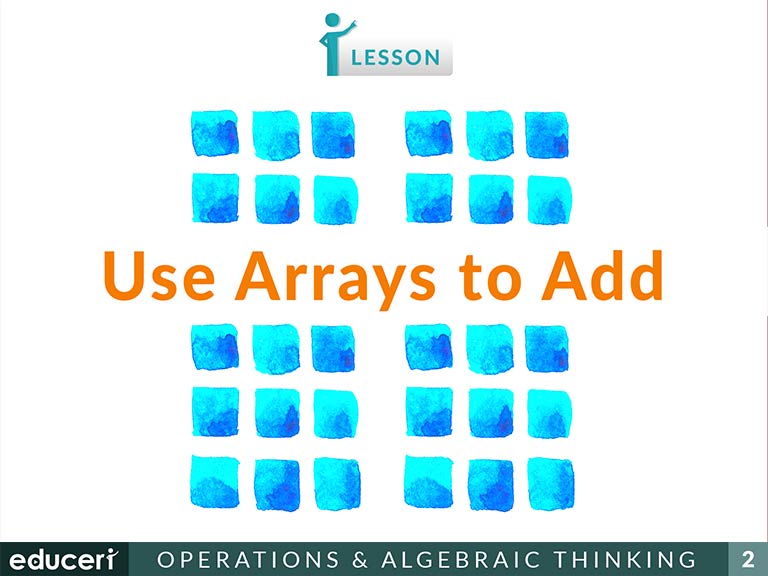
Use Arrays (Addition)
- Grade:
- 2
- Subject:
- Math
This number sense lesson focuses on using arrays to multiply. The lesson includes research-based strategies and questions that help prepare students for assessments. In this lesson, students complete the number sentence. Then, they use the first number to find the array that has the matching number of rows, and the second number to find the array that has the matching number of columns. Finally, students select the correct array, count the number of objects, and read the number sentence. In addition to the lesson, there are eight pages of Independent Practice and review with questions modeled after current adaptive testing items.
Memorize the Multiplication Facts for 2
- Grade:
- 3
- Subject:
- Math
This number sense lesson focuses on memorizing multiplication facts for 2. The lesson includes research-based strategies and questions that help prepare students for assessments. In this lesson, students practice reading aloud, writing/filling in the product, and writing the entire multiplication fact for the number 2. In addition to the lesson, there are four pages of Independent Practice and review with questions modeled after current adaptive testing items.
Memorize the Multiplication Facts for 10
- Grade:
- 3
- Subject:
- Math
This number sense lesson focuses on memorizing multiplication facts for 10. The lesson includes research-based strategies and questions that help prepare students for assessments. In this lesson, students practice reading aloud, writing/filling in the product, and writing the entire multiplication fact for the number 10. In addition to the lesson, there are four pages of Independent Practice and review with questions modeled after current adaptive testing items.
Memorize the Multiplication Facts for 5
- Grade:
- 3
- Subject:
- Math
This number sense lesson focuses on memorizing multiplication facts for 5. The lesson includes research-based strategies and questions that help prepare students for assessments. In this lesson, students practice reading aloud, writing/filling in the product, and writing the entire multiplication fact for the number 5. In addition to the lesson, there are four pages of Independent Practice and review with questions modeled after current adaptive testing items.
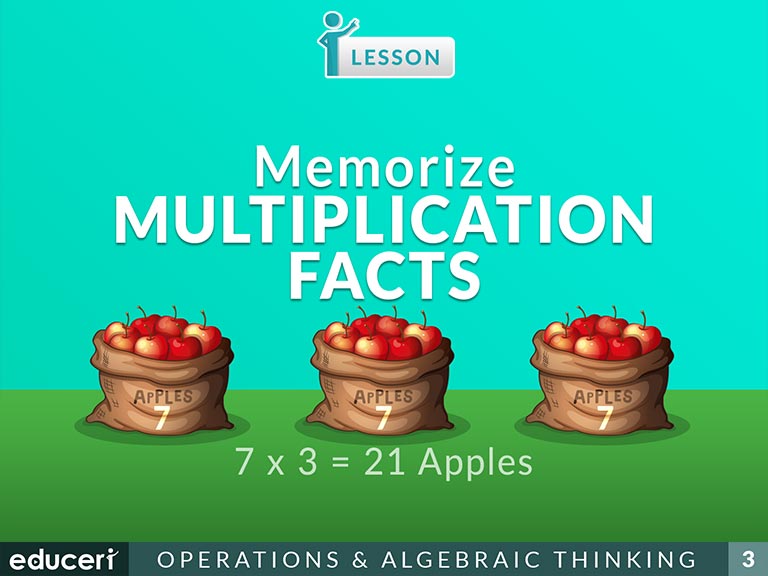
Memorize Multiplication Facts
- Grade:
- 3
- Subject:
- Math
This operations and algebraic thinking lesson covers how to memorize multiplication facts. The lesson includes research-based strategies and strategic questions that prepare students for assessments. In this lesson, students will practice the multiplication facts of numbers 2 through 10 by a combination of reading aloud and writing each fact many times in horizontal and vertical formats.
Add Fractions with Denominators 10 & 100

- Grade:
- 4
- Subject:
- Math
Express a fraction with denominator 10 as an equivalent fraction with denominator 100, and use this technique to add two fractions with respective denominators 10 and 100.* For example, express 3/10 as 30/100, and add 3/10 + 4/100 = 34/100.
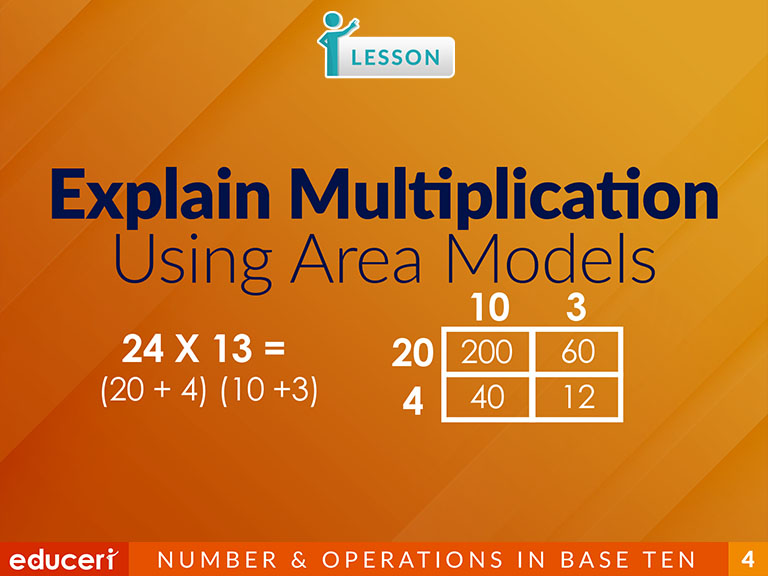
Explain Multiplication Using Area Models
- Grade:
- 4
- Subject:
- Math
This number sense lesson focuses on using the relationship between multiplication and division to check answers. The lesson includes research-based strategies and questions that help prepare students for assessments. In this lesson, students write both factors in expanded form. Then, they set up the box model to perform multiplication in. Then, students find the answer by adding up all the box values. In addition to the lesson, there are four pages of Independent Practice and Periodic Reviews with questions modeled after current adaptive testing items.
Determine All Factor Pairs of Numbers
- Grade:
- 4
- Subject:
- Math
This operations and algebraic thinking lesson teaches students how to determine all the factor pairs of a number. The lesson includes research-based strategies and strategic questions that prepare students for assessments. In this lesson, students will determine all of the factor pairs of a given number. This is in preparation for later mathematics where students will need to determine a variety of factors for fractions, factoring equations, and several other uses for this particular skill. It is an excellent introduction to factoring and provides several real-world examples for students to practice with.
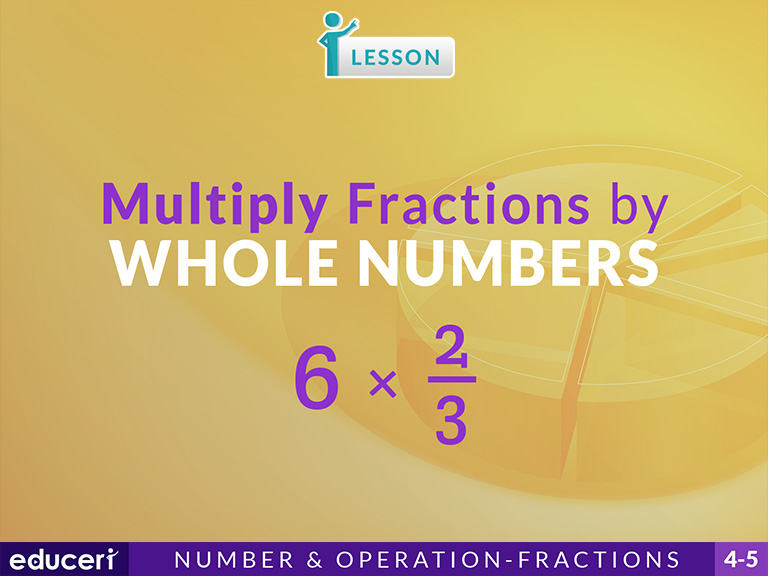
Fraction Word Problems: Multiplication
- Grade:
- 4
- Subject:
- Math
Solve word problems involving multiplication of a fraction by a whole number, e.g., by using visual fraction models and equations to represent the problem. For example, if each person at a party will eat 3/8 of a pound of roast beef, and there will be 5 people at the party, how many pounds of roast beef will be needed? Between what two whole numbers does your answer lie?
Multiply by Multiples of 10, 100, and 1000
- Grade:
- 4
- Subject:
- Math
This number and operations in base ten lesson teaches students how to multiply numbers by multiples of 10, 100, and 1,000. The lesson includes research-based strategies and strategic questions that prepare students for assessments. In this lesson, students will multiply numbers by multiples of 10, 100, and 1,000 and multiples of 10 by multiples of 10 in preparation for more complex multi-digit multiplication in the future. This lesson focuses on the simplification of complex multiplication problems into simpler ones to facilitate relatively easy multiplication.
Multiply a Multi-Digit Number By a One-Digit Number (with Composing)
- Grade:
- 4
- Subject:
- Math
This number sense lesson focuses on multiplying numbers with regrouping. The lesson includes research-based strategies and questions that help prepare students for assessments. In this lesson, students multiply the bottom number with each digit of the top number, regrouping if needed (add the regrouped number, if needed). Then, they read the product aloud. In addition to the lesson, there are four pages of Independent Practice and review with questions modeled after current adaptive testing items.
Use the Relationship Between Multiplication & Division
- Grade:
- 4
- Subject:
- Math
This number sense lesson focuses on using the relationship between multiplication and division to check answers. The lesson includes research-based strategies and questions that help prepare students for assessments. In this lesson, students identify the operation needed to check the answer. Then, they set up the multiplication or division problem and identify the numbers used to create the problem. Finally, students check the answer by solving the problem. In addition to the lesson, there are four pages of Independent Practice and review with questions modeled after current adaptive testing items.
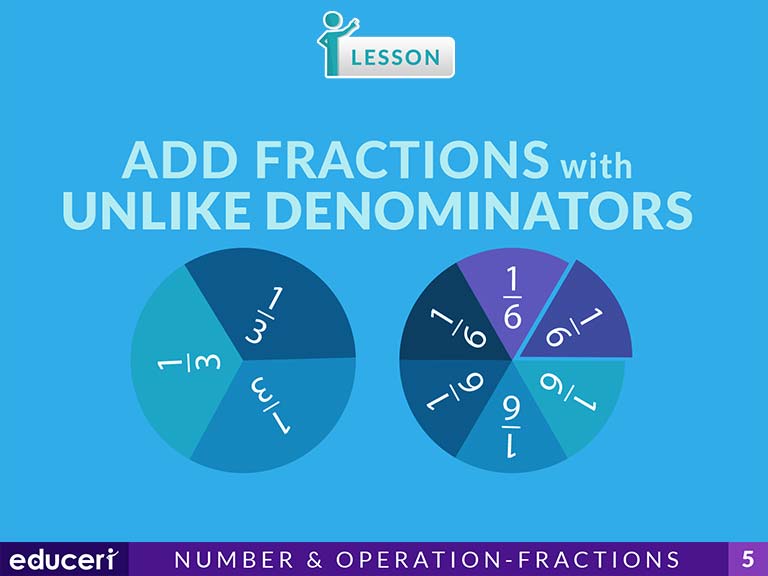
Multiply Decimal Numbers
- Grade:
- 5
- Subject:
- Math
This number sense lesson focuses on multiplying decimal numbers. The lesson includes research-based strategies and strategic questions that prepare students for assessments. In this lesson, students multiply the bottom factor with each digit of the top factor, regrouping if needed. Then, they count the total number of decimal places in the two factors and place a decimal in the product that many places to the left. In addition to the lesson, there are four pages of Independent Practice and Periodic Reviews with questions modeled after current adaptive testing items.
Fraction Word Problems: Multiplication
- Grade:
- 5
- Subject:
- Math
This fractions word problems lesson covers the meaning of fraction multiplication. The lesson includes research-based strategies and strategic questions that prepare students for common assessments and performance tasks. In this lesson, students will read multiplication word problems and draw models to understand what it means to find a fraction of a fraction.
Multiply Fractions
- Grade:
- 5
- Subject:
- Math
This lesson addresses fraction multiplication at the fluency level.
Divide Unit Fractions by Whole Numbers
- Grade:
- 5
- Subject:
- Math
This lesson focuses on the fluency of dividing a unit fraction by a whole number. Although the purpose of the lesson is to teach the process, there are opportunities for students to conceptually examine, read, and write about the structure of a unit fraction being divided by a whole number.
Evaluate Algebraic Expressions Using Substitution (Exponents 2 of 2)
- Grade:
- 6
- Subject:
- Math
This algebra and functions lesson focuses on evaluating expressions by using the order of operations. The lesson includes research-based strategies and strategic questions that prepare students for assessments. In this lesson, students substitute the given value of each variable into the expression. Then, they evaluate the expression by determining which operation to perform first (using PEMDAS) and repeating the order until no more operations can be performed. Finally, they compute the value and interpret the answer. In addition to the lesson, there are four pages of Independent Practice and review with questions modeled after current adaptive testing items and 12 flashcards for the order of operations.
Solve Problems Involving Proportional Relationships
- Grade:
- 6
- Subject:
- Math
This ratios and proportional relationships lesson teaches students how to solve problems involving proportional relationships. The lesson includes research-based strategies and strategic questions that prepare students for assessments. In this lesson, students will identify a given ratio in a word problem, then the unknown ratio. They will represent the proportional relationship in a table and generate an equivalent ratio to solve for the unknown. Finally, they will interpret the solution.
Evaluate Numerical Expressions
- Grade:
- 6
- Subject:
- Math
This equations and expressions lesson teaches students how to evaluate numerical expressions. The lesson includes research-based strategies and strategic questions that prepare students for assessments. In this lesson, students evaluate numerical expressions using the order of operations.
Evaluate Numerical Expressions Involving Exponents
- Grade:
- 6
- Subject:
- Math
This number sense lesson focuses on computing exponents. The lesson includes research-based strategies and strategic questions that prepare students for assessments. In this lesson, students read the problem, identifying the base and the exponent. Then, they rewrite the exponent as a repeated multiplication, find the product, and interpret it. In addition to the lesson, there are nine pages of Independent Practice and Periodic Reviews with questions modeled after current adaptive testing items.
Calculate a Percent of a Quantity
- Grade:
- 6
- Subject:
- Math
This number sense lesson focuses on calculating a percent of a quantity. The lesson includes research-based strategies and strategic questions that prepare students for assessments. In this lesson, students read the question and identify the percent and quantity. Then, they calculate the percent of a quantity by changing the statement into a multiplication problem and multiplying the quantity by a percent. Finally, they interpret the percent of the quantity. In addition to the lesson, there are ten pages of Independent Practice and Periodic Reviews with questions modeled after current adaptive testing items.
Solve Problems Involving Tips
- Grade:
- 7
- Subject:
- Math
This number sense lesson focuses on solving problems involving tips. The lesson includes research-based strategies and strategic questions that prepare students for assessments. In this lesson, students read the problem, identifying the initial tip percent and the initial amount paid. Then, they convert the tip percentage to a decimal number and calculate the tip by multiplying the tip decimal and initial amount paid. Finally, they calculate the total amount paid by adding the initial amount and the tip, and then they interpret the total amount paid in a complete sentence. In addition to the lesson, there are eight pages of Independent Practice and review with questions modeled after current adaptive testing items.
Apply the Properties of Exponents
- Grade:
- 8
- Subject:
- Math
This expressions and equations lesson teaches students how to apply the properties of exponents. The lesson includes research-based strategies and strategic questions that prepare students for assessments. In this lesson, students will apply the properties of exponents to create equivalent expressions. There are flashcards for this lesson to review the concept that exponents must have the same base for multiplication and division to be used.
Simplify Expressions Using Exponential Rules
- Grade:
- High School, High School 9-10, High School 11-12
- Subject:
- Math
Multiply Rational Expressions
- Grade:
- High School
- Subject:
- Math
This Algebra 1 lesson teaches students how to multiply rational expressions. The lesson includes research-based strategies and strategic questions that prepare students for assessments. Students will factor the polynomials in the numerator and denominator, if possible, and then reduce common factors if possible. Finally, they will multiply the rational expressions. In addition to the lesson, there is one page of Independent Practice and three pages of periodic review.
Add, Subtract, and Multiply Polynomials
- Grade:
- High School, High School 9-10, High School 11-12
- Subject:
- Math
Add, Subtract, and Multiply Polynomials
- Grade:
- High School, High School 9-10, High School 11-12
- Subject:
- Math
Simplify Expressions Using Exponential Rules
- Grade:
- High School, High School 9-10, High School 11-12
- Subject:
- Math
Add, Subtract, and Multiply Polynomials
- Grade:
- High School, High School 9-10, High School 11-12
- Subject:
- Math
Simplify Expressions Using Exponential Rules
- Grade:
- High School, High School 9-10, High School 11-12
- Subject:
- Math