
Lessons tagged with "rational"
Add & Subtract Rational Numbers
- Grade:
- 7
- Subject:
- Math
This number system lesson covers how to add and subtract rational numbers. The lesson includes research-based strategies and strategic questions that prepare students for assessments. In this lesson, students first rewrite subtraction to add the opposite if needed. Then, they determine which addition rule to use, apply it, and interpret the answer.
Convert Rational Numbers to Decimals
- Grade:
- 7
- Subject:
- Math
This number sense lesson focuses on converting rational numbers (as fractions) to decimals. The lesson includes research-based strategies and strategic questions that prepare students for assessments. In this lesson, students identify the numerator and denominator of the fraction. Then, they convert the fraction to a decimal by using long division to divide the numerator by the denominator, inserting placeholder zeroes until the division is complete, and aligning place values to correctly place the decimal point. Finally, they interpret the answer. In addition to the lesson, there are four pages of Independent Practice and review with questions modeled after current adaptive testing items.
Distinguish Between Rational & Irrational Numbers
- Grade:
- 8
- Subject:
- Math
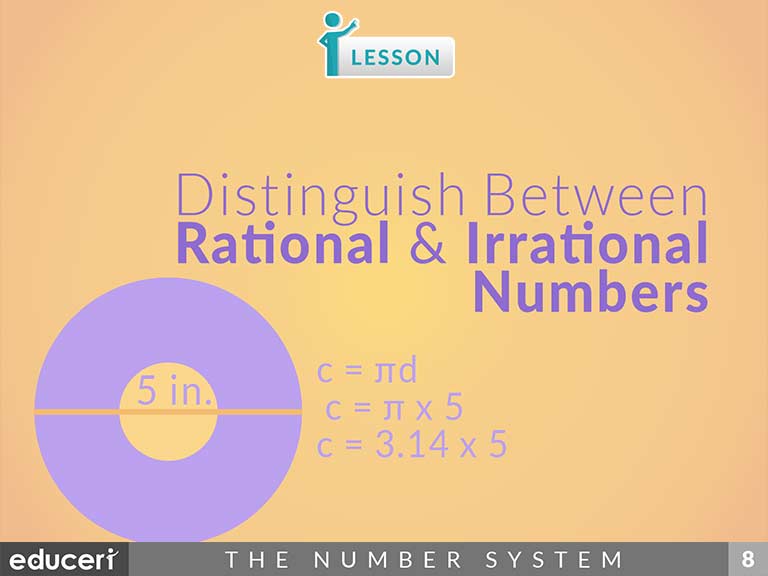
This number system lesson teaches students how to distinguish between rational and irrational numbers. The lesson includes research-based strategies and strategic questions that prepare students for assessments. In this lesson, students will distinguish between various types of numbers, including irrational numbers, integers, and whole numbers.
Add Rational Expressions
- Grade:
- High School, High School 9-10
- Subject:
- Math
This Algebra 1 lesson teaches students how to add rational expressions. The lesson includes research-based strategies and strategic questions that prepare students for assessments. Students will factor the polynomials in the denominator completely, if possible, and then create equivalent fractions by finding the common denominator by multiplying the numerator and denominator of each fraction by the same rational expression. Finally, they will add the rational expressions by combining like terms in the numerator, and simplifying if needed. In addition to the lesson, there is one page of Independent Practice and three pages of periodic review.
Simplify Rational Expressions by Factoring
- Grade:
- High School
- Subject:
- Math
This Algebra 1 lesson teaches students how to simplify rational expressions by factoring. The lesson includes research-based strategies and strategic questions that prepare students for assessments. Students will factor the polynomial in the numerator completely, if possible, and then the denominator. Finally, they will simplify the fraction by reducing common polynomials factors in the numerator and the denominator. In addition to the lesson, there is one page of Independent Practice and three pages of periodic review.
Multiply Rational Expressions
- Grade:
- High School
- Subject:
- Math
This Algebra 1 lesson teaches students how to multiply rational expressions. The lesson includes research-based strategies and strategic questions that prepare students for assessments. Students will factor the polynomials in the numerator and denominator, if possible, and then reduce common factors if possible. Finally, they will multiply the rational expressions. In addition to the lesson, there is one page of Independent Practice and three pages of periodic review.
Extend the Properties of Exponents to Rational Exponents
- Grade:
- High School, High School 9-10
- Subject:
- Math
Extend the Properties of Exponents to Rational Exponents
- Grade:
- High School, High School 9-10
- Subject:
- Math
Add Rational Expressions
- Grade:
- High School, High School 9-10
- Subject:
- Math
This Algebra 1 lesson teaches students how to add rational expressions. The lesson includes research-based strategies and strategic questions that prepare students for assessments. Students will factor the polynomials in the denominator completely, if possible, and then create equivalent fractions by finding the common denominator by multiplying the numerator and denominator of each fraction by the same rational expression. Finally, they will add the rational expressions by combining like terms in the numerator, and simplifying if needed. In addition to the lesson, there is one page of Independent Practice and three pages of periodic review.