
All Lessons
Share This Lesson
Develop a Topic with Supporting Details
Share This Lesson
Write a Concluding Paragraph for Expository Text
This writing strategies lesson focuses on writing a concluding paragraph for expository text. The lesson includes research-based strategies and strategic questions that prepare students for assessments. In this lesson, students read a passage and identify the main idea and supporting details. Then, they select the best sentence to add to the end of the text to build a better conclusion and write a conclusion. In addition to the lesson, there are six pages of Independent Practice and review with questions modeled after current adaptive testing items.
Share This Lesson
Plan an Opinion Piece
W.6.1 Write arguments to support claims with clear reasons and relevant evidence.
W.6.1.AW.6.1.A Introduce claim(s) and organize the reasons and evidence clearly.
W.6.1.BW.6.1.B Support claim(s) with clear reasons and relevant evidence, using credible sources and demonstrating an understanding of the topic or text.
W.6.1.CW.6.1.C Use words, phrases, and clauses to clarify the relationships among claim(s) and reasons.
W.6.1.DW.6.1.D Establish and maintain a formal style.
W.6.1.EW.6.1.E Provide a concluding statement or section that follows from the argument presented.
This writing lesson covers how to plan an opinion piece. The lesson includes research-based strategies and strategic questions that prepare students for assessments. In this lesson, students read the topic and decide their position about it. Then they identify three appeals for their position, focusing on logical, emotional, and ethical. They also restate their position for a summary. In addition to the lesson, there are four pages of new topics for review.
Share This Lesson
Write an Opinion Piece
W.6.1 Write arguments to support claims with clear reasons and relevant evidence.
W.6.1.AW.6.1.A Introduce claim(s) and organize the reasons and evidence clearly.
W.6.1.BW.6.1.B Support claim(s) with clear reasons and relevant evidence, using credible sources and demonstrating an understanding of the topic or text.
W.6.1.CW.6.1.C Use words, phrases, and clauses to clarify the relationships among claim(s) and reasons.
W.6.1.DW.6.1.D Establish and maintain a formal style.
W.6.1.EW.6.1.E Provide a concluding statement or section that follows from the argument presented.
This writing lesson covers how to write an opinion piece. The lesson includes research-based strategies and strategic questions that prepare students for assessments. In this lesson, students write an introduction that introduces the topic and states their position. Then, they write paragraphs that use logical, emotional, or ethical appeals to the audience. Finally, they write a summary paragraph that restates their position. These sentences are based on the planning charts created in the Plan an Opinion Piece lesson. In addition to the lesson, there are four pages of new topics for review.
Share This Lesson
Plan and Write a Cause and Effect Essay
W.6.2 Write informative/explanatory texts to examine a topic and convey ideas, concepts, and information through the selection, organization, and analysis of relevant content.
W.6.2.AW.6.2.A Introduce a topic; organize ideas, concepts, and information, using strategies such as definition, classification, comparison/contrast, and cause/effect; include formatting (e.g., headings), graphics (e.g., charts, tables), and multimedia when useful to aiding comprehension.
W.6.2.BW.6.2.B Develop the topic with relevant facts, definitions, concrete details, quotations, or other information and examples.
W.6.2.CW.6.2.C Use appropriate transitions to clarify the relationships among ideas and concepts.
W.6.2.DW.6.2.D Use precise language and domain-specific vocabulary to inform about or explain the topic.
W.6.2.EW.6.2.E Establish and maintain a formal style.
W.6.2.FW.6.2.F Provide a concluding statement or section that follows from the information or explanation presented.
This writing lesson covers how to plan informative text. The lesson includes research-based strategies and strategic questions that prepare students for assessments. In this lesson, students read the research and identify related information that is needed to complete a graphic organizer. Then they complete the graphic organizer which asks for topic, three facts and details, and a conclusion. In addition to the lesson, there are four pages of facts and details related to topics for review and organizing.
Share This Lesson

Plan and Write Informative Text
W.6.2 Write informative/explanatory texts to examine a topic and convey ideas, concepts, and information through the selection, organization, and analysis of relevant content.
W.6.2.AW.6.2.A Introduce a topic; organize ideas, concepts, and information, using strategies such as definition, classification, comparison/contrast, and cause/effect; include formatting (e.g., headings), graphics (e.g., charts, tables), and multimedia when useful to aiding comprehension.
W.6.2.BW.6.2.B Develop the topic with relevant facts, definitions, concrete details, quotations, or other information and examples.
W.6.2.CW.6.2.C Use appropriate transitions to clarify the relationships among ideas and concepts.
W.6.2.DW.6.2.D Use precise language and domain-specific vocabulary to inform about or explain the topic.
W.6.2.EW.6.2.E Establish and maintain a formal style.
W.6.2.FW.6.2.F Provide a concluding statement or section that follows from the information or explanation presented.
Share This Lesson
Revise Writing to Improve Organization of Ideas Between Paragraphs
Share This Lesson
Share This Lesson
Recognize Descriptive Phrases
This writing lesson covers how to recognize descriptive details, such as adjectives, adverbs, and prepositional phrases. The lesson includes research-based strategies and strategic questions that prepare students for assessments. In this lesson, students will identify the descriptive phrase, then identify which word the phrase describes. Finally, they will determine what the descriptive phrase gives more details about. Also, passages of descriptive text are provided with questions about the descriptive phrases.
Share This Lesson
Use Descriptive Phrases
This writing lesson covers how to use descriptive phrases, such as adjectives, adverbs, and prepositional phrases to be more precise. The lesson includes research-based strategies and strategic questions that prepare students for assessments. In this lesson, students are given a basic sentence along with instructions for adding a type of feeling, color, motion, shape, etc. Students select the most precise descriptive phrase and rewrite the sentence with the new phrase.
Share This Lesson
Plan and Write a Narrative
This writing lesson requires students to write a previously planned narrative. The lesson includes research-based strategies and strategic questions that prepare students for assessments. In this lesson, Students take their notes from the previous lesson and write a first draft of their narrative and edit their composition.
Share This Lesson
Share This Lesson
Determine the Meaning of Words Using Roots & Affixes
This language/vocabulary lesson covers how to determine the meaning of words using roots and affixes. The lesson includes research-based strategies and strategic questions that prepare students for assessments. In this lesson, students will learn how to analyze words in a sentence based on given root definitions.
Share This Lesson
Ensure That Pronouns Are in the Proper Case
This language lesson covers the use of pronouns in the proper case. The lesson includes research-based strategies and strategic questions that prepare students for assessments. In this lesson, students will learn when to use subjective, objective, and possessive case forms of pronouns.
Share This Lesson
Determine the Meaning of Unknown Words Using Context Clues
L.6.4 Determine or clarify the meaning of unknown and multiple-meaning words and phrases based on grade 6 reading and content, choosing flexibly from a range of strategies.
L.6.4.AL.6.4.A Use context (e.g., the overall meaning of a sentence or paragraph; a word's position or function in a sentence) as a clue to the meaning of a word or phrase.
Share This Lesson
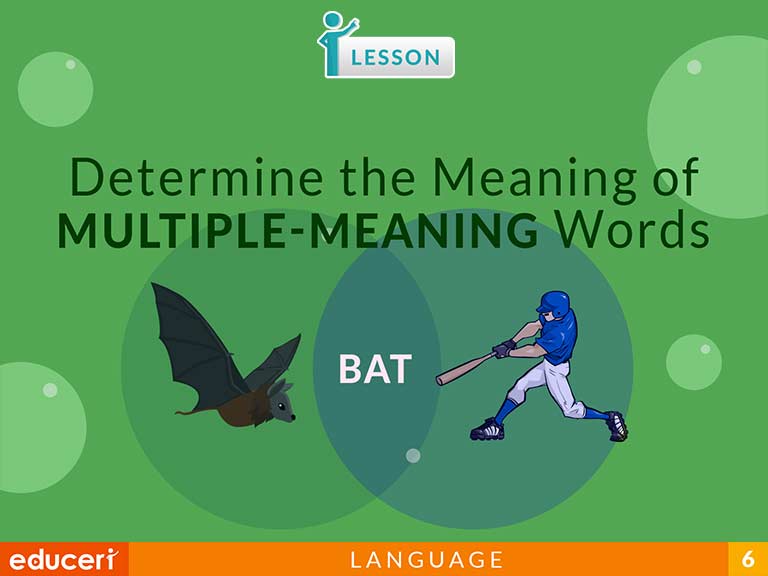
Determine the Meaning of Multiple-Meaning Words
L.6.4 Determine or clarify the meaning of unknown and multiple-meaning words and phrases based on grade 6 reading and content, choosing flexibly from a range of strategies.
L.6.4.AL.6.4.A Use context (e.g., the overall meaning of a sentence or paragraph; a word's position or function in a sentence) as a clue to the meaning of a word or phrase.
Share This Lesson
Interpret Hyperbole in a Sentence
This language lesson covers how to identify and interpret hyperbole. The lesson includes research-based strategies and strategic questions that prepare students for assessments. In this lesson, students will develop the skill of looking for an exaggerated phrase in a text that stretches the truth about something, and then interpreting its meaning.
Share This Lesson
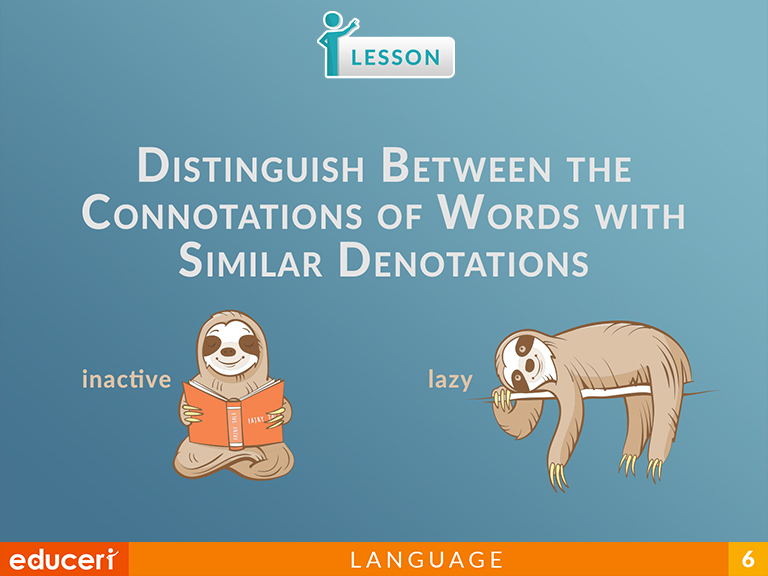
Distinguish Between the Connotations of Words with Similar Denotations
This language lesson covers how to distinguish between connotations of words with similar denotations. The lesson includes research-based strategies and strategic questions that prepare students for assessments. In this lesson, students will analyze sentences for context clues that suggest which of three similar words can be used in the sentence based on each word’s denotation and connotation.
Share This Lesson
Punctuate Sentences with Appositives
This writing conventions lesson focuses on identifying appositives. The lesson includes research-based strategies and strategic questions that prepare students for assessments. In this lesson, students read the sentence, looking for noun phrases. Then, they identify if the noun is followed by an appositive, insert a comma to separate the appositive from the rest of the sentence and read it aloud. In addition to the lesson, there are four pages of Independent Practice and review with questions modeled after current adaptive testing items.