
All Lessons

Use Colons
Share This Lesson

Use Semicolons
Share This Lesson
Interpret Word Connotations
Share This Lesson
Analyze the Features of Functional Documents
Share This Lesson

Identify Word Derivations
Share This Lesson
Critique the Logic of Functional Documents
Share This Lesson

Share This Lesson
Simplify Radical Expressions
(A) Simplify numerical radical expressions involving square roots
A2.7.G(G) Rewrite radical expressions that contain variables to equivalent forms
HSN.RN.1 Explain how the definition of the meaning of rational exponents follows from extending the properties of integer exponents to those values, allowing for a notation for radicals in terms of rational exponents. For example, we define 5^(1/3) to be the cube root of 5 because we want (5^(1/3))^3 = (5^(1/3))^3 to hold, so (5^(1/3))^3 must equal 5.
HSN.RN.2HSN.RN.2 Rewrite expressions involving radicals and rational exponents using the properties of exponents.
This number sense lesson focuses on simplifying radical expressions. The lesson includes research-based strategies and strategic questions that prepare students for assessments. In this lesson, students read the radical expression and identify the radicand. Then, they find the prime factors of the radical expression and rewrite it as the product of prime factors of the radicand. Finally, they simplify the radical expression and interpret the solution. In addition to the lesson, there are four pages of Independent Practice and review with questions modeled after current adaptive testing items.
Share This Lesson
Extend the Properties of Exponents to Rational Exponents
Share This Lesson
Graph Linear Inequalities (Slope-Intercept Form)
Share This Lesson
Solve Multistep Equations
This Algebra 1 lesson teaches students how to solve multi-step equations. The lesson includes research-based strategies and strategic questions that prepare students for assessments. Students will simplify each expression if needed. Then, they will isolate the variable terms on one side of the equation and the numerical terms on the other side. Finally, they will solve for the variable and interpret the solution. In addition to the lesson, there are three pages of Independent Practice and six pages of periodic review as well as three assessment questions based on the Common Core tests.
Share This Lesson
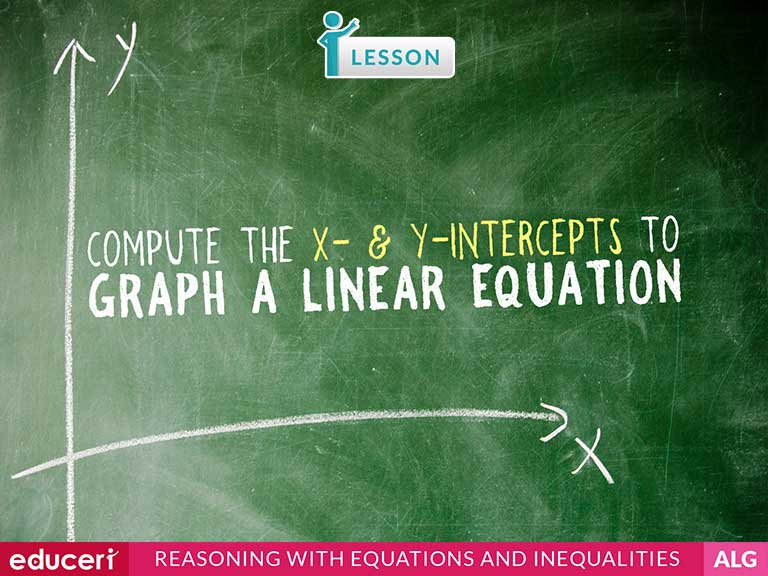
Compute X- and Y-Intercepts to Graph a Linear Equation
HSA.CED.2 Create equations in two or more variables to represent relationships between quantities; graph equations on coordinate axes with labels and scales.
HSA.REI.10HSA.REI.10 Understand that the graph of an equation in two variables is the set of all its solutions plotted in the coordinate plane, often forming a curve (which could be a line).
HSF.IF.7HSF.IF.7 Graph functions expressed symbolically and show key features of the graph, by hand in simple cases and using technology for more complicated cases.*
HSF.IF.7.AHSF.IF.7.A Graph linear and quadratic functions and show intercepts, maxima, and minima.
This Algebra 1 lesson teaches students how to compute the x- and y-intercepts to graph a linear equation. The lesson includes research-based strategies and strategic questions that prepare students for assessments. Students will compute the x-intercept and y-intercept by substituting zero appropriately and solving. Then, they will plot the x- and y-intercepts, and finally graph and label the linear equation. In addition to the lesson, there are two pages of Independent Practice and six pages of periodic review.
Share This Lesson
Divide a Polynomial by a Monomial
Share This Lesson
Verify if an Ordered Pair is a Solution to a Linear Equation
This Algebra 1 lesson teaches students how to verify that an ordered pair is the solution to a linear equation. The lesson includes research-based strategies and strategic questions that prepare students for assessments. Students will identify the linear equation, and verify if the ordered pair is a solution by substituting values into the linear equation and evaluating. Finally, they will plot the point on the coordinate plane and interpret the result both algebraically and graphically. In addition to the lesson, there is one page of Independent Practice and three pages of periodic review.
Share This Lesson

Solve Inequalities Involving Absolute Value
This Algebra 1 lesson teaches students how to solve inequalities involving absolute values. The lesson includes research-based strategies and strategic questions that prepare students for assessments. Students will read the absolute value inequality and determine whether it is a positive or negative type. Then, they will solve for x in both inequalities, graph them on a number line, and interpret the solution. In addition to the lesson, there is one page of Independent Practice and three pages of Periodic Review.
Share This Lesson
Solve a System of Two Linear Equations in Two Variables Algebraically
HSA.REI.5 Prove that, given a system of two equations in two variables, replacing one equation by the sum of that equation and a multiple of the other produces a system with the same solutions.
HSA.REI.6HSA.REI.6 Solve systems of linear equations exactly and approximately (e.g., with graphs), focusing on pairs of linear equations in two variables.
Share This Lesson
Share This Lesson
Multiply Polynomials
Share This Lesson
Simplify Rational Expressions by Factoring
This Algebra 1 lesson teaches students how to simplify rational expressions by factoring. The lesson includes research-based strategies and strategic questions that prepare students for assessments. Students will factor the polynomial in the numerator completely, if possible, and then the denominator. Finally, they will simplify the fraction by reducing common polynomials factors in the numerator and the denominator. In addition to the lesson, there is one page of Independent Practice and three pages of periodic review.
Share This Lesson
Add Rational Expressions
This Algebra 1 lesson teaches students how to add rational expressions. The lesson includes research-based strategies and strategic questions that prepare students for assessments. Students will factor the polynomials in the denominator completely, if possible, and then create equivalent fractions by finding the common denominator by multiplying the numerator and denominator of each fraction by the same rational expression. Finally, they will add the rational expressions by combining like terms in the numerator, and simplifying if needed. In addition to the lesson, there is one page of Independent Practice and three pages of periodic review.