
All Lessons
Multiply Rational Expressions
This Algebra 1 lesson teaches students how to multiply rational expressions. The lesson includes research-based strategies and strategic questions that prepare students for assessments. Students will factor the polynomials in the numerator and denominator, if possible, and then reduce common factors if possible. Finally, they will multiply the rational expressions. In addition to the lesson, there is one page of Independent Practice and three pages of periodic review.
Share This Lesson

Solve Quadratic Equations by Factoring
HSA.REI.4 Solve quadratic equations in one variable.
HSA.REI.4.BHSA.REI.4.B Solve quadratic equations by inspection (e.g., for x^2 = 49), taking square roots, completing the square, the quadratic formula and factoring, as appropriate to the initial form of the equation. Recognize when the quadratic formula gives complex solutions and write them as a ± bi for real numbers a and b.
Share This Lesson
Solve Rate Problems
HSN.Q.1 Use units as a way to understand problems and to guide the solution of multi-step problems; choose and interpret units consistently in formulas; choose and interpret the scale and the origin in graphs and data displays.
HSA.CED.1HSA.CED.1 Create equations and inequalities in one variable and use them to solve problems. Include equations arising from linear and quadratic functions, and simple rational and exponential functions.
This Algebra 1 lesson teaches students how to solve rate problems. The lesson includes research-based strategies and strategic questions that prepare students for assessments. Students will identify whether the problem is a distance addition or equal distance model. Then, they will organize the information using a distance, rate, and timetable, representing unknown values algebraically. Finally, they will set up an equation using distances, solve for the unknown rate or time, find remaining unknown values, and interpret the solution in a complete sentence. In addition to the lesson, there are two pages of Independent Practice and six pages of periodic review.
Share This Lesson
Solve Quadratic Equations Using the Quadratic Formula
HSA.REI.4 Solve quadratic equations in one variable.
HSA.REI.4.AHSA.REI.4.A Use the method of completing the square to transform any quadratic equation in x into an equation of the form (x - p)2 = q that has the same solutions. Derive the quadratic formula from this form.
HSA.REI.4.BHSA.REI.4.B Solve quadratic equations by inspection (e.g., for x^2 = 49), taking square roots, completing the square, the quadratic formula and factoring, as appropriate to the initial form of the equation. Recognize when the quadratic formula gives complex solutions and write them as a ± bi for real numbers a and b.
Share This Lesson
Determine How Many Times the Graph of a Quadratic Function Intersects the X-Axis
(A) Graph quadratic functions on the coordinate plane and use the graph to identify key attributes, if possible, including x-intercept, y-intercept, zeros, maximum value, minimum values, vertex, and the equation of the axis of symmetry
A1.8.A(A) Solve quadratic equations having real solutions by factoring, taking square roots, completing the square, and applying the quadratic formula
HSA.REI.4 Solve quadratic equations in one variable.
HSA.REI.4.BHSA.REI.4.B Solve quadratic equations by inspection (e.g., for x^2 = 49), taking square roots, completing the square, the quadratic formula and factoring, as appropriate to the initial form of the equation. Recognize when the quadratic formula gives complex solutions and write them as a ± bi for real numbers a and b.
Share This Lesson
Graph the Solution Set to a System of Linear Inequalities
Share This Lesson
Convert Linear Equations in Standard Form to Slope-Intercept Form
Share This Lesson
Solve Equations with Unknown Coefficients
(A) Solve linear equations in one variable, including those for which the application of the distributive property is necessary and for which variables are included on both sides
A1.12.E(E) Solve mathematic and scientific formulas, and other literal equations, for a specified variable.
Share This Lesson
Solve Compound Inequalities
Share This Lesson
Add, Subtract, and Multiply Polynomials
Share This Lesson
Solve Multi-Step Linear Inequalities
Share This Lesson
Factor Quadratic Expressions - Part 1
(8) Quadratic functions and equations. The student applies the mathematical process standards to solve, with and without technology, quadratic equations and evaluate the reasonableness of their solutions. The student formulates statistical relationships and evaluates their reasonableness based on real-world data.
A1.8.A(A) Solve quadratic equations having real solutions by factoring, taking square roots, completing the square, and applying the quadratic formula
Share This Lesson
Factor Quadratic Expressions - Part 2
(8) Quadratic functions and equations. The student applies the mathematical process standards to solve, with and without technology, quadratic equations and evaluate the reasonableness of their solutions. The student formulates statistical relationships and evaluates their reasonableness based on real-world data.
A1.8.A(A) Solve quadratic equations having real solutions by factoring, taking square roots, completing the square, and applying the quadratic formula
Share This Lesson
Solve Exponential Equations
(C) Write exponential functions in the form f(x) = abx (where b is a rational number) to describe problems arising from mathematical and real-world situations, including growth and decay
A2.5.D(D) Solve exponential equations of the form y = abx where a is a nonzero real number and b is greater than zero and not equal to one and single logarithmic equations having real solutions
PCAL.5.I(I) Generate and solve exponential equations in mathematical and real-world problems
Share This Lesson
Simplify Expressions in Equations
Share This Lesson
Solve Quadratic Equations by Completing the Square
HSA.REI.4.A Use the method of completing the square to transform any quadratic equation in x into an equation of the form (x - p)2 = q that has the same solutions. Derive the quadratic formula from this form.
HSA.REI.4.BHSA.REI.4.B Solve quadratic equations by inspection (e.g., for x^2 = 49), taking square roots, completing the square, the quadratic formula and factoring, as appropriate to the initial form of the equation. Recognize when the quadratic formula gives complex solutions and write them as a ± bi for real numbers a and b.
Share This Lesson
Solve Linear Equation Word Problems
Share This Lesson
Graph Linear Functions by Plotting Ordered Pairs
(C) Contrast bivariate sets of data that suggest a linear relationship with bivariate sets of data that do not suggest a linear relationship from a graphical representation
A1.3.C(C) Graph linear functions on the coordinate plane and identify key features, including x-intercept, y-intercept, zeros, and slope, in mathematical and real-world problems
8.EE.6 Use similar triangles to explain why the slope m is the same between any two distinct points on a non-vertical line in the coordinate plane; derive the equation y = mx for a line through the origin and the equation y = mx + b for a line intercepting the vertical axis at b.
HSA.REI.10HSA.REI.10 Understand that the graph of an equation in two variables is the set of all its solutions plotted in the coordinate plane, often forming a curve (which could be a line).
HSF.IF.7.AHSF.IF.7.A Graph linear and quadratic functions and show intercepts, maxima, and minima.
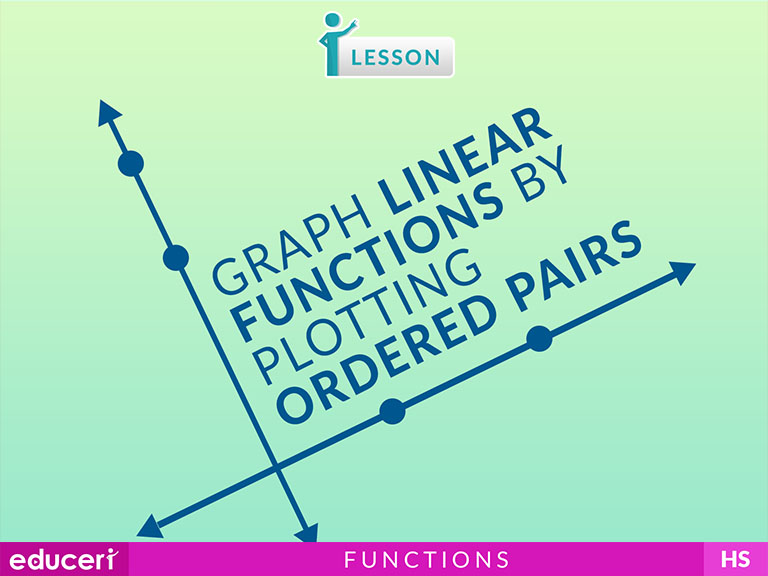
This expressions and equations lesson teaches students how to graph linear functions by plotting ordered pairs. The lesson includes research-based strategies and strategic questions that prepare students for assessments. In this lesson, students will plot ordered pairs from a linear function on the coordinate plane.
Share This Lesson
Identify Quadratic Function Graphs
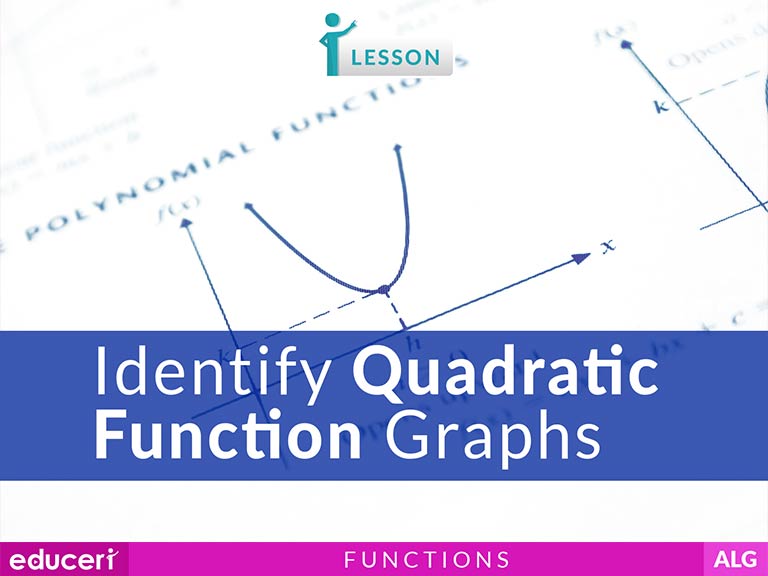
(7) Quadratic functions and equations. The student applies the mathematical process standards when using graphs of quadratic functions and their related transformations to represent in multiple ways and determine, with and without technology, the solutions to equations.
A1.7.A(A) Graph quadratic functions on the coordinate plane and use the graph to identify key attributes, if possible, including x-intercept, y-intercept, zeros, maximum value, minimum values, vertex, and the equation of the axis of symmetry
A1.7.B(B) Describe the relationship between the linear factors of quadratic expressions and the zeros of their associated quadratic functions
A1.7.C(C) Determine the effects on the graph of the parent function f(x) = x2 when f(x) is replaced by af(x), f(x) + d, f(x - c), f(bx) for specific values of a, b, c, and d.