
All Lessons
Write Numbers Using Expanded Form
This numbers and operations in base ten lesson covers how to write numbers in expanded form. The lesson includes research-based strategies and strategic questions that prepare students for assessments. In this lesson, students are asked to identify the place value of each digit in a three-digit number, and then write the number as the addition of the value of each digit.
Share This Lesson
Compare Three-Digit Numbers Using Symbols
This numbers and operations in base ten lesson covers how to compare three-digit numbers using symbols. The lesson includes research-based strategies and strategic questions that prepare students for assessments. In this lesson, students are asked to compare each digit of a pair of three-digit numbers, starting at the highest place value. Then, they identify which number is less than, greater than, or equal to, and write the correct symbol.
Share This Lesson
Add Two-Digit Numbers (With Composing)
Share This Lesson
Subtract Two-Digit Numbers (With Decomposing)
This number sense lesson focuses on subtracting numbers (two digits long). The lesson includes research-based strategies and questions that help prepare students for assessments. In this lesson, students determine if regrouping is needed. Then, they subtract digits in the ones place, and in the tens place. Finally, students read the problem and sum aloud. In addition to the lesson, there are "lining up subtraction" flashcards along with seven pages of Independent Practice and review with questions modeled after current adaptive testing items.
Share This Lesson
Add Three-Digit Numbers (With Regrouping)
This number sense lesson focuses on adding numbers (three digits). The lesson includes research-based strategies and questions that help prepare students for assessments. In this lesson, students add the digits in the one's place and regroup if the sum is ten or more. Then, they add the digits in the tens place and regroup if the sum is 10 or more. Finally, students read the addition problem and the sum aloud. In addition to the lesson, there are four pages of Independent Practice and review with questions modeled after current adaptive testing items.
Share This Lesson
Add Two-Digit Numbers (Without Composing)
This number sense lesson focuses on adding numbers (no regrouping). The lesson includes research-based strategies and questions that help prepare students for assessments. In this lesson, students add the digits in the ones column, the tens column, and then the hundreds column, if needed. Then, they read the problem and the sum aloud. In addition to the lesson, there are eight pages of Independent Practice and review with questions modeled after current adaptive testing items.
Share This Lesson
Add Up To Four Two-Digit Numbers
This Common Core numbers and operations in base ten lesson covers how to add multiple two-digit numbers. The lesson includes research-based strategies and strategic questions that prepare students for Common Core assessments. In this lesson, students are asked to add the digits by place value. Students are also asked to regroup any group of ten or more with concept demonstrations to show what regrouping means in real terms. In addition to the lesson, there are four pages of Independent Practice with questions modeled after the Common Core assessment items.
Share This Lesson
Subtract Two-Digit Numbers (Without Decomposing)
Share This Lesson
Subtract Three Digit Numbers with Decomposing
Share This Lesson
Solve subtraction word problems
Share This Lesson
Solve Addition Word Problems
2.OA.1 Use addition and subtraction within 100 to solve one- and two-step word problems involving situations of adding to, taking from, putting together, taking apart, and comparing, with unknowns in all positions, e.g., by using drawings and equations with a symbol for the unknown number to represent the problem.
2.NBT.72.NBT.7 Add and subtract within 1000, using concrete models or drawings and strategies based on place value, properties of operations, and/or the relationship between addition and subtraction; relate the strategy to a written method. Understand that in adding or subtracting three-digit numbers, one adds or subtracts hundreds and hundreds, tens and tens, ones and ones; and sometimes it is necessary to compose or decompose tens or hundreds.
Share This Lesson
Measure the Length of an Object Using Different Units
Share This Lesson
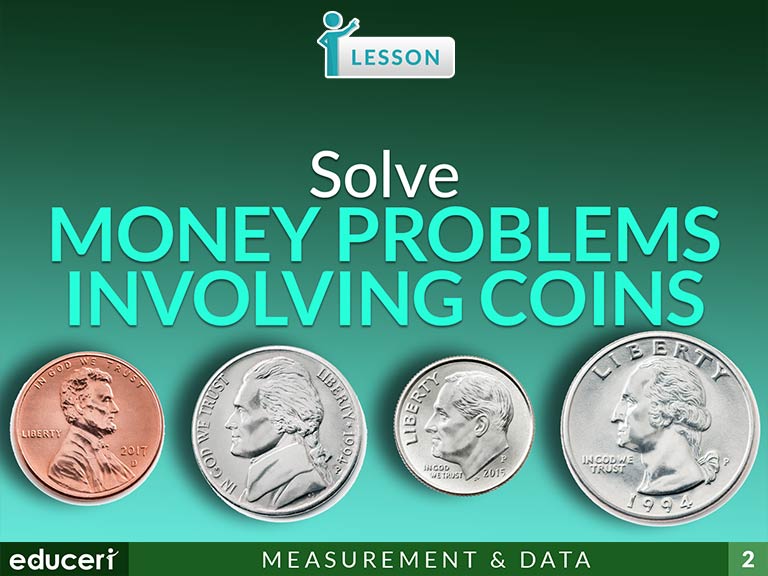
Solve Money Problems Involving Coins
This measurement and data lesson covers the solving of money problems involving coins. The lesson includes research-based strategies and strategic questions that prepare students for assessments. In this lesson, students will identify the number of coins both visually and in words, note their value, and then combine by counting coins to find the sum.
Share This Lesson
Solve Money Problems Involving Bills & Coins
This measurement and data lesson covers the solving of money problems involving bills and coins. The lesson includes research-based strategies and strategic questions that prepare students for assessments. In this lesson, students will identify the number of bills and coins both visually and in words, note their value, and then combine by counting the bills then coins to find the sum.
Share This Lesson
Measure the Length of an Object to the Nearest Inch
This measurement and data lesson focuses on measuring the length of an object to the nearest inch. The lesson includes research-based strategies and questions that help prepare students for assessments. In this lesson, students line up the zero mark on the ruler with the object. Then, then find the length of the object by counting the inches to the nearest inch. Finally, they record the length and read the sentence. In addition to the lesson, there are eight pages of Independent Practice and review with questions modeled after current adaptive testing items.
Share This Lesson
Measure the Length of an Object to the Nearest Centimeter
Share This Lesson
Measure the Length of an Object in Inches
This measurement and geometry lesson focuses on measuring the length of an object to inches The lesson includes research-based strategies and questions that help prepare students for assessments. In this lesson, students line up the zero mark of the ruler with the object. Then, then find the length of the object by counting the number of inches. Finally, they record the length and read the sentence. In addition to the lesson, there are eight pages of Independent Practice and review with questions modeled after current adaptive testing items. Examples of different rulers are shown.
Share This Lesson
Represent Data in More Than One Way
Share This Lesson
Tell Time to the Nearest Five Minutes
This measurement and geometry lesson focuses on telling time to the nearest five minutes. The lesson includes research-based strategies and questions that help prepare students for assessments. In this lesson, students identify the correct time on a clock and write the hour and minutes in the spaces provided. Then, they determine if the time is a quarter past or a quarter to. In addition to the lesson, there are eight pages of Independent Practice and review with questions modeled after current adaptive testing items.
Share This Lesson
Draw a Bar Graph
Draw a picture graph and a bar graph (with single-unit scale) to represent a data set with up to four categories. Solve simple put-together, take-apart, and compare problems using the information presented in a bar graph.