All Lessons
Combine Sentences with Appositives
This writing conventions lesson focuses on combining sentences with appositives. The lesson includes research-based strategies and strategic questions that prepare students for assessments. In this lesson, students identify the noun in the first sentence and the noun phrase in the second. Then students are asked to combine the sentences with appositives. In addition to the lesson, there are four pages of Independent Practice and review with questions modeled after current adaptive testing items.
Share This Lesson
Explain the Function of Conjunctions in Simple Sentences
This writing conventions lesson focuses on identifying types of simple sentences. The lesson includes research-based strategies and strategic questions that prepare students for assessments. In this lesson, students read the sentences and label the subject and verb, noting whether there is a compound subject, a compound verb, or neither. In addition to the lesson, there are four pages of Independent Practice and review with questions modeled after current adaptive testing items.
Share This Lesson
Identify and Use Modifiers
This writing conventions lesson focuses on identifying and using modifiers. The lesson includes research-based strategies and strategic questions that prepare students for assessments. In this lesson, students read the sentences, identifying the descriptive word or modifier. Then, they draw an arrow to the word it is modifying, determine whether the modifier is an adjective or adverb, and use the modifier in a sentence. In addition to the lesson, there are four pages of Independent Practice and review with questions modeled after current adaptive testing items.
Share This Lesson
Combine Sentences with Participial Phrases
This writing conventions lesson focuses on combining sentences with participial phrases. The lesson includes research-based strategies and strategic questions that prepare students for assessments. In this lesson, students combine sentences by inserting a participial phrase and comma in the correct place. In addition to the lesson, there are four pages of Independent Practice and review with questions modeled after current adaptive testing items.
Share This Lesson
Identify Homographs
L.5.4 Determine or clarify the meaning of unknown and multiple-meaning words and phrases based on grade 5 reading and content, choosing flexibly from a range of strategies.
L.5.4.AL.5.4.A Use context (e.g., cause/effect relationships and comparisons in text) as a clue to the meaning of a word or phrase.
This reading vocabulary lesson focuses on identifying homographs. The lesson includes research-based strategies and strategic questions that prepare students for assessments. In this lesson, students read three sentences that use the homograph with different meanings. Then, they read two possible meanings and identify context clues to help explain which meaning fits with which sentence. In addition to the lesson, there are four pages of Independent Practice and review with questions modeled after current adaptive testing items.
Share This Lesson
Explain the Use of Figurative Language
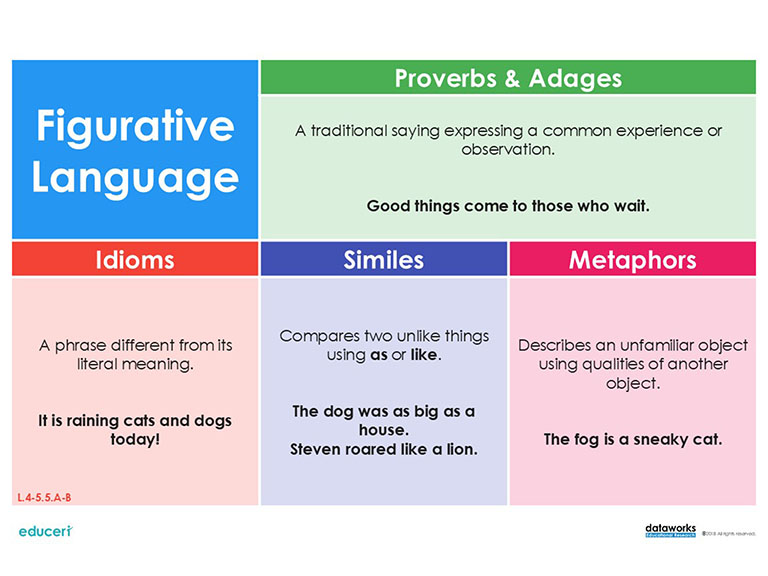
This reading vocabulary lesson focuses on explaining the use of figurative language. The lesson includes research-based strategies and strategic questions that prepare students for assessments. In this lesson, students identify instances of figurative language and then use context clues to help them interpret the meaning of the phrase. In addition to the lesson, there are four pages of Independent Practice and review with questions modeled after current adaptive testing items.
Share This Lesson
Correct Shift Errors in Verb Tense
This Common Core language lesson covers how to avoid shift errors in verb tense, especially in the compound and complex sentences. The lesson includes research-based strategies and strategic questions that prepare students for Common Core assessments. In this lesson, students will learn how to match the verb tense to the time a verb’s action takes place. In addition to the lesson, there are four pages of Independent Practice with questions modeled after the Common Core assessment items.
Share This Lesson
Form and Use Perfect Tense Verbs
This language lesson covers how to form and use perfect tense verbs. The lesson includes research-based strategies and strategic questions that prepare students for assessments. In this lesson, students read a pair of sentences, identify the verbs, and then identify which sentence contains the perfect tense verb.
Share This Lesson
Recognize & Explain the Meaning of Idioms
This Common Core language lesson teaches students how to recognize and interpret frequently used idioms. This lesson is very impactful for English learners or ELD students. The lesson includes research-based strategies and strategic questions that prepare students for Common Core assessments. In this lesson, students look at the literal and figurative meanings of the idioms side-by-side. Then in the activity they use the context of the text to interpret the meaning of idioms. In addition to the lesson, there are four pages of Independent Practice with questions modeled after the Common Core assessment items.
Share This Lesson
Explain the Meaning of Similes & Metaphors
This Common Core language lesson teaches students how to interpret figurative language including similes and metaphors. The lesson includes research-based strategies and strategic questions that prepare students for Common Core assessments. In this lesson, students will learn how to identify a simile or metaphor in the context of a paragraph and how to use the context of the text to explain the meaning of the figurative language. In addition to the lesson, there are four pages of Independent Practice with questions modeled after the Common Core assessment items.
Share This Lesson
Use Commas Correctly
L.5.2 Demonstrate command of the conventions of standard English capitalization, punctuation, and spelling when writing.
L.5.2.BL.5.2.B Use a comma to separate an introductory element from the rest of the sentence.
L.5.2.CL.5.2.C Use a comma to set off the words yes and no (e.g., Yes, thank you), to set off a tag question from the rest of the sentence (e.g., It's true, isn't it?), and to indicate direct address (e.g., Is that you, Steve?).
This Language lesson has students correctly use commas to separate different items in a sentence. Students will both insert commas where necessary and explain the reason that a comma is necessary there. The lesson includes research-based strategies and strategic questions that prepare students for assessments. In addition to the lesson, there are eight pages of independent practice and review.
Share This Lesson
Use Parentheses in Expressions
5.OA.1 Use parentheses, brackets, or braces in numerical expressions, and evaluate expressions with these symbols.
5.OA.25.OA.2 Write simple expressions that record calculations with numbers, and interpret numerical expressions without evaluating them. For example, express the calculation "add 8 and 7, then multiply by 2" as 2 × (8 + 7). Recognize that 3 × (18932 + 921) is three times as large as 18932 + 921, without having to calculate the indicated sum or product.
This algebra and functions lesson focuses on using parentheses in expressions. The lesson includes research-based strategies and questions that help prepare students for assessments. In this lesson, students write the given expression twice. Then, they insert parentheses around different locations of the expression and evaluate each expression to determine which is correct. Finally, students interpret their answer and read aloud. In addition to the lesson, there are four pages of Independent Practice and Periodic Reviews with questions modeled after current adaptive testing items.
Share This Lesson
Determine the Prime Factorization of Numbers
This number sense lesson focuses on determining the prime factorization of numbers. The lesson includes research-based strategies and strategic questions that prepare students for assessments. In this lesson, students determine the prime factorization of the number using a factorization tree, factoring all composite numbers until they are prime. Finally, they write the prime factorization using exponents if necessary and checking and interpreting the answer. In addition to the lesson, there are twelve pages of Independent Practice and review with questions modeled after current adaptive testing items.