All Lessons
Plan and Write an Opinion Piece
W.5.1 Write opinion pieces on topics or texts, supporting a point of view with reasons and information.
W.5.1.AW.5.1.A Introduce a topic or text clearly, state an opinion, and create an organizational structure in which ideas are logically grouped to support the writer's purpose.
W.5.1.BW.5.1.B Provide logically ordered reasons that are supported by facts and details.
W.5.1.CW.5.1.C Link opinion and reasons using words, phrases, and clauses (e.g., consequently, specifically).
W.5.1.DW.5.1.D Provide a concluding statement or section related to the opinion presented.
This writing lesson covers how to plan an opinion piece. The lesson includes research-based strategies and strategic questions that prepare students for assessments. In this lesson, students read the prompt and decide their position about it. Then they organize their ideas in a planning chart by answering questions about their position and three reasons for it. They make sure their reasons appeal to the audience by using pronouns and modal verbs. They also restate their position for a summary. In addition to the lesson, there are four pages of new topics for review.
Share This Lesson
Edit Writing
In this Common Core writing lesson, students will practice rereading and editing texts. In this lesson, students will edit texts for proper capitalization, punctuation, and spelling. In addition to the lesson, there are four pages of Independent Practice and review modeled after the Common Core assessment items.
Share This Lesson
Write a Paragraph
This Common Core writing lesson uses teacher guidance and support to help students write a paragraph that is appropriate to the task and purpose. In this lesson, students will review a topic, write a topic sentence, add details, and a concluding idea in a graphic organizer. Then, they will write a paragraph. In addition to the lesson, there are four pages of Independent Practice and review modeled after the Common Core assessment items.
Share This Lesson
Plan and Write a Narrative
W.5.3 Write narratives to develop real or imagined experiences or events using effective technique, descriptive details, and clear event sequences.
W.5.3.AW.5.3.A Orient the reader by establishing a situation and introducing a narrator and/or characters; organize an event sequence that unfolds naturally.
W.5.3.BW.5.3.B Use narrative techniques, such as dialogue, description, and pacing, to develop experiences and events or show the responses of characters to situations.
W.5.3.CW.5.3.C Use a variety of transitional words, phrases, and clauses to manage the sequence of events.
W.5.3.DW.5.3.D Use concrete words and phrases and sensory details to convey experiences and events precisely.
W.5.3.EW.5.3.E Provide a conclusion that follows from the narrated experiences or events.
This Common Core writing lesson requires students to plan and write a narrative. The lesson includes research-based strategies and strategic questions that prepare students for Common Core assessments. In this lesson, students are given a prompt and must plan a situation, setting, characters, events, and resolution. Students then take their notes and write a first draft of their narrative. Lesson also includes a checklist for students to reference and a printable graphic organizer for repeated use. In addition to the lesson, there are four pages of Independent Practice with questions modeled after the Common Core assessment items.
Share This Lesson
Plan and Write a Main Idea Essay
Share This Lesson
Write a Conclusion for Persuasive Text
Share This Lesson
Determine the Meaning of Unknown Words Using Context Clues
Share This Lesson
Explain the Function of Conjunctions
This language lesson covers the use of conjunctions (coordinating and subordinating) in terms of how they connect words, phrases, or clauses by showing different relationships. The lesson includes research-based strategies and strategic questions that prepare students for assessments. In this lesson, students will learn when to use various conjunctions by explaining the relationship of the two parts they are connecting.
Share This Lesson
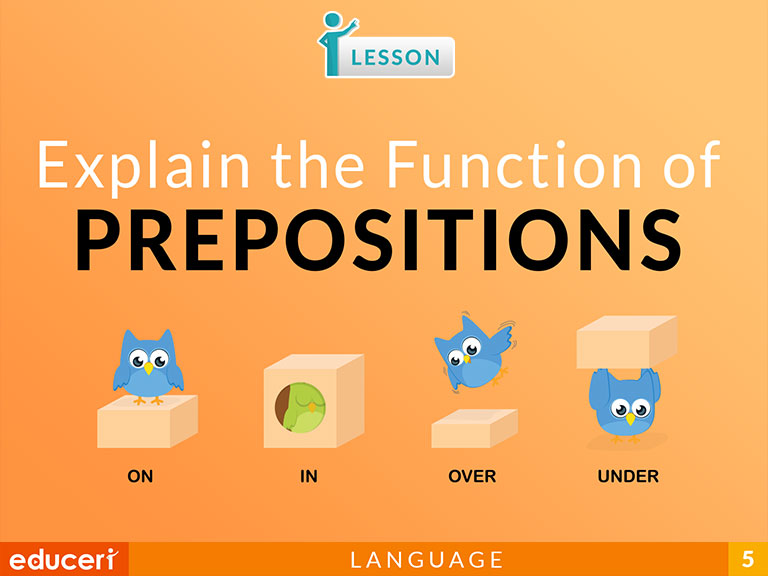
Explain the Function of Prepositions
This language lesson covers the use of prepositional phrases (defined as a group of words that begins with a preposition) by how their relationship to other words or phrases. The lesson includes research-based strategies and strategic questions that prepare students for assessments. In this lesson, students will learn when to use prepositional phrases that show time, place or direction, and means or agency (how).
Share This Lesson
Separate Items in a Series
This language lesson covers how to separate items in a series, using commas and semicolons. The lesson includes research-based strategies and strategic questions that prepare students for assessments. In this lesson, students will learn how to identify a series of items, where to put the commas, and when to use a semicolon.
Share This Lesson
Identify Independent & Dependent Clauses in Sentences
This writing conventions lesson focuses on identifying independent and dependent clauses. The lesson includes research-based strategies and strategic questions that prepare students for assessments. In this lesson, students read the sentence and identify the independent clause, if any, by labeling SV and underlining. Then, they identify the dependent clause, if any, by labeling cSV and double underlining. Common subordinating conjunctions are provided for reference. In addition to the lesson, there are four pages of Independent Practice and review with questions modeled after current adaptive testing items.
Share This Lesson
Identify Prepositional Phrases
This writing conventions lesson focuses on identifying prepositional phrases. The lesson includes research-based strategies and strategic questions that prepare students for assessments. In this lesson, students read the sentence and determine the preposition (based on a given table). Then, they identify the full prepositional phrase and whether the phrases shows position in space or time. In addition to the lesson, there are four pages of Independent Practice and review with questions modeled after current adaptive testing items.
Share This Lesson
Use Roots to Determine the Meaning of Words
This reading vocabulary lesson focuses on using roots to determine the meaning of unknown words. The lesson includes research-based strategies and strategic questions that prepare students for assessments. In this lesson, students identify the root in a bold word in a sentence. They note the origin and meaning from a given table and then determine the best meaning of the word based on context clues. In addition to the lesson, there are 11 pages of Independent Practice and review with questions modeled after current adaptive testing items.
Share This Lesson
Explain Antonyms Using Text
Share This Lesson
Explain Frequently Used Synonyms
This reading vocabulary lesson focuses on explaining frequently used synonyms. The lesson includes research-based strategies and strategic questions that prepare students for assessments. In this lesson, students read a sentence with a bold word. They identify context clues in the sentence that explain its meaning and then determine the correct synonym for the bold word. Finally, they write and read the synonyms. In addition to the lesson, there are four pages of Independent Practice and review with questions modeled after current adaptive testing items.
Share This Lesson
Use Prefixes to Analyze the Meaning of Words
This reading vocabulary lesson focuses on using prefixes to analyze the meaning of words. The lesson includes research-based strategies and strategic questions that prepare students for assessments. In this lesson, students read a sentence and identify the word with the prefix. Then, they divide the word between base and prefix and then determine the meaning of the prefix from a table. Finally, they combine the meanings of the prefix and the base to determine the meaning of the whole word. In addition to the lesson, there are fifteen pages of Independent Practice and review with questions modeled after current adaptive testing items.
Share This Lesson
Use Suffixes to Analyze the Meaning of Words
Share This Lesson
Determine How Complex Sentences are Related
This writing conventions lesson focuses on identifying complex sentences. The lesson includes research-based strategies and strategic questions that prepare students for assessments. In this lesson, students read the sentence and identify the subject and verb in the independent clause, and the subject, verb, and subordinating conjunction in the dependent clause. Then they identify the type of complex sentence (cSV, SV or SV cSV), and finally write how the clauses are related. In addition to the lesson, there are four pages of Independent Practice and review with questions modeled after current adaptive testing items.
Share This Lesson
Use Quotations Marks Around Titles
This writing conventions lesson focuses on using quotation marks around titles. The lesson includes research-based strategies and strategic questions that prepare students for assessments. In this lesson, students read each sentence, looking for a title. Then, they insert quotation marks around the title of the work, if needed. Finally, they select the correctly punctuated sentence from four choices. In addition to the lesson, there are four pages of Independent Practice and review with questions modeled after current adaptive testing items.
Share This Lesson