
All Lessons
Follow Two-Step Directions
Share This Lesson
Describe an Experience
Share This Lesson
Match Pictures to Words and Sentences
Share This Lesson
Share This Lesson
Share This Lesson
Share This Lesson
Present Explanatory Text
K.S5.I-2 Demonstrate increasing awareness of differences between informal "playground speech" and language appropriate to the classroom.
K.S6.B-2K.S6.B-2 Follow increasing number of rules for discussion about familiar topics.
K.S7.I-2K.S7.I-2 Participate in shared research and writing projects by evaluating and communicating findings.
Share This Lesson
Print Uppercase & Lowercase Letters
This concepts of print lesson requires students to practice the printing of upper and lower-case letters. The lesson includes research-based strategies and strategic questions that prepare students for assessments. Unlike most EDI lessons, these lessons do not have Independent Practice and Periodic Review for the students to perform individually. Each letter includes a short Concept Development followed by Guided Practice; as a result, each page is labeled with the corresponding letter (e.g., Concept Development: A, Skill Development/Guided Practice: J, etc.). These lessons can be done in any order and are currently arranged in alphabetical order.
Share This Lesson
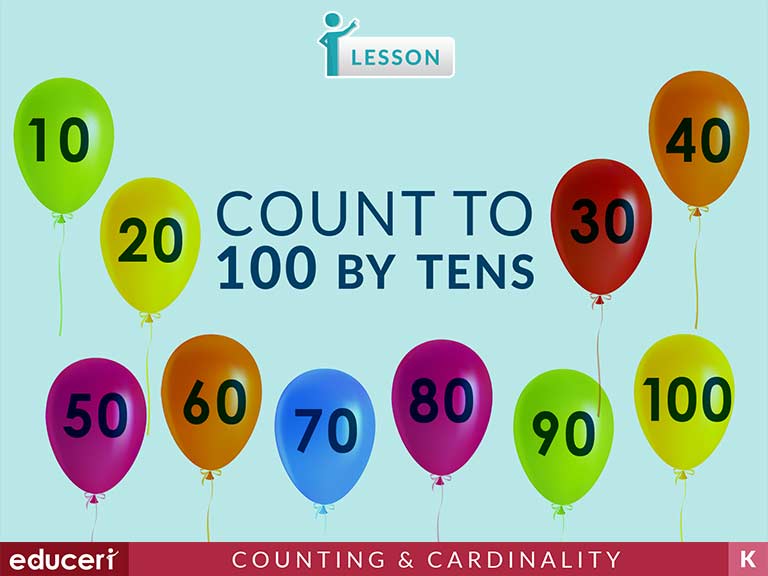
Count to 100 By Tens
Share This Lesson
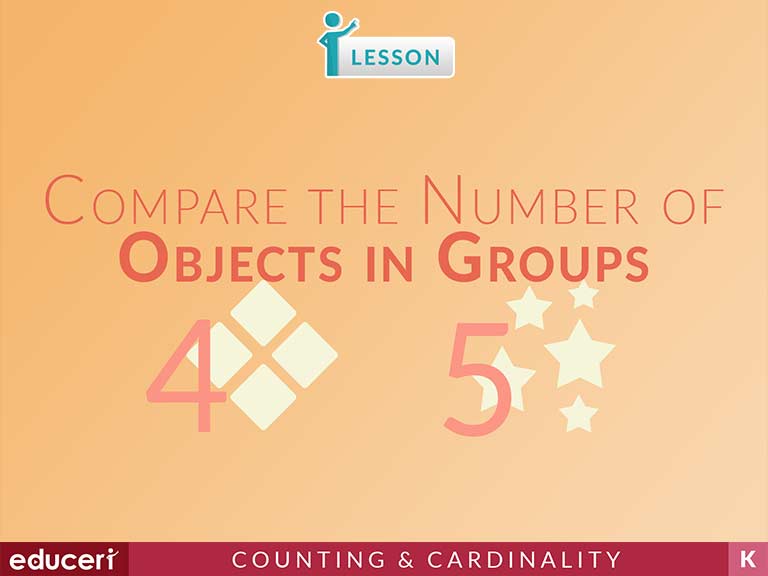
Compare The Number of Objects in Group
Share This Lesson
Share This Lesson
Share This Lesson
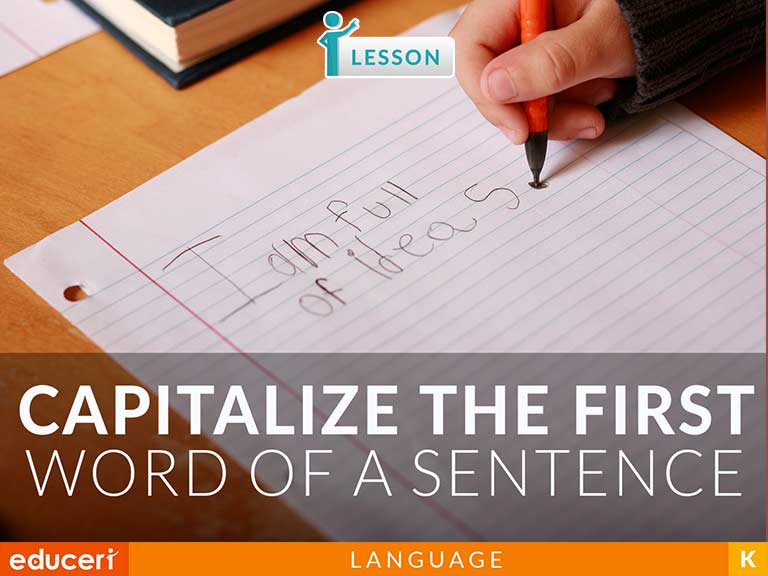
Capitalize the First Word of a Sentence
This writing conventions lesson focuses on capitalizing the first word of a sentence The lesson includes research-based strategies and questions that help prepare students for assessments. This lesson practices using uppercase letters as a rule when writing the first word in a sentence. In addition to the lesson, there are four pages of Independent Practice and review with questions modeled after current adaptive testing items.
Share This Lesson
Identify Which Set Has Less Than
This number sense lesson focuses on identifying which set has less than. The lesson includes research-based strategies and strategic questions that prepare students for assessments. In this lesson, the students count each set in a pair and write the numbers. Then, they identify which set has less than and explain why. In addition to the lesson, there are four pages of Independent Practice and review modeled on current adaptive testing items.
Share This Lesson
Identify Which Set Has More Than
This number sense lesson focuses on identifying which set has more than. The lesson includes research-based strategies and strategic questions that prepare students for assessments. In this lesson, the students count each set in a pair and write the numbers. Then, they identify which set has more than and explain why. In addition to the lesson, there are four pages of Independent Practice and review modeled on current adaptive testing items.
Share This Lesson
Order Numbers (11-20)
Share This Lesson
Share This Lesson
Ordenar los numeros
Share This Lesson
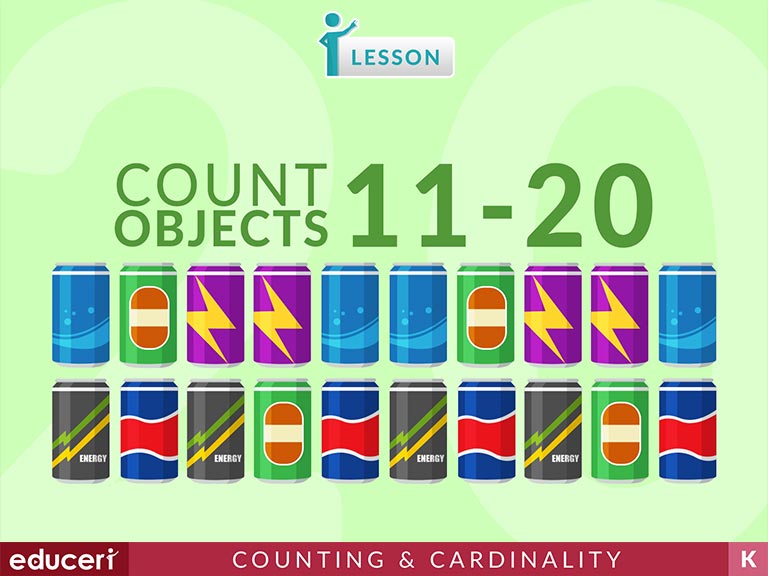
Count Objects (11-20)
K.CC.4 Understand the relationship between numbers and quantities; connect counting to cardinality.
K.CC.4.AK.CC.4.A When counting objects, say the number names in the standard order, pairing each object with one and only one number name and each number name with one and only one object.
K.CC.4.BK.CC.4.B Understand that the last number name said tells the number of objects counted. The number of objects is the same regardless of their arrangement or the order in which they were counted.
K.CC.4.CK.CC.4.C Understand that each successive number name refers to a quantity that is one larger.
K.CC.5K.CC.5 Count to answer "how many?" questions about as many as 20 things arranged in a line, a rectangular array, or a circle, or as many as 10 things in a scattered configuration; given a number from 1-20, count out that many objects.